Words in, words out

When I started this blog it was not only to talk about things I’m reading, but also my own writing… but that’s an aspect I haven’t written about at all, yet, in this space.

So, a quick recap for those of you who don’t know who I am, or only know me through the electronic music “M. Griffin,” or know me personally but didn’t know I was into writing fiction.

I was a Lit major in college, at University of Oregon in the 80s. During that time, when I wasn’t worshipping at the Ernest Hemingway altar in my off-campus apartment, or hanging around with my Zelda Fitzgerald-like girlfriend of that year, I was experimenting with words, writing weird poetry, even weirder one-act surrealist plays, and gradually a bit of short fiction. My last year, I set myself the goal of writing a novel before I graduated. I did complete an angst-ridden, rather immature novel called Bright Fever, but it was more of an exercise than a serious attempt to write something that might be published, and I never even seriously considered sending it out.

After college I became more serious about short stories and wrote a couple dozen terse, minimalistic stories that I sent out to magazines without much luck (only one short fragment published in Missisippi Review), and took a couple of slightly more ambitious attempts at the novel.

Some time in my late twenties, while living in Seattle, I wrote another angst-ridden and rather immature novel called Hum. This one was a lot more interesting, getting into territory that might be called metaphysical or surrealist, having to do with a protagonist who learns how to “shift” reality slightly so that he’s able to exit out of the world inhabited by other people, and move about in a differently-shaded version of the Seattle he knows, but with virtually all the people gone.

Hum never went anywhere (again, didn’t send it out to any publishers or agents or really anybody outside my household), but it remains a concept I’d like to revisit and possibly incorporate into a more broad and complex idea I’ve had. So there may be more discussion of that title here in the future.

Not long after that, I moved back to Portland and entered a 3-day Novel contest, and one Memorial Day weekend sat down with two cases of Coca Cola and wrote, from two pages of notes, a short novel called House of Longest Days. I had originally planned a story by that title about people who inhabit a house that allows them to live in a young, carefree and surrounded-by-friends state forever, but this concept was somewhat more normal than original plan. It ended up being a story about a handful of former college friends retreating to the large home of one wealthy friend (does it sound like The Big Chill yet?) and sort of catching up on each other, realizing how different they’ve all become, and airing all their unresolved bullshit. It’s actually much less like The Big Chill than my synopsis makes it sound, and much stranger… the basement of the house has a number of secret or semi-secret “theme” rooms into which people disappear for little adventures (the room of fire, the room of color, the pillow room, etc.) This one was, finally, sent off to be read by people unrelated to me. My third novel did not win the contest, but I didn’t expect it would.
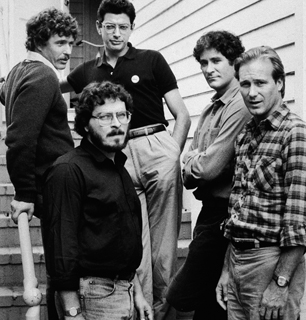
Big Chill

I continued with the short stories for a while, and became a bit more ambitious, and a bit less terse and minimal (communing just as often with the spirit of Fitzgerald as Hemingway), though I had also discovered Raymond Carver by that time and become obsessed by him, so who knows.

Then I was about to turn thirty, and went through a really awful breakup after which I took a break from writing. I figured I would pick up again (and I even have some notes and outlines I put on paper during the “not writing for a while” stage) but I became involved in ambient music, started recording my own material, started my record label and became too busy with that to work on any of the other creative activities I’d previously enjoyed.

Somehow I always knew that I would find my way back to writing fiction, and I hoped that my new “life experience” and maturity would allow me to be more brutally honest and self-critical when I resumed writing again.

Fast forward, now, twelve years or so.

I was married a couple of years ago to a fantastic woman named Lena who is very supportive and encouraging of all my creative urges and endeavors. At some point she gave voice to an idea that I’d heard in my head a few times, which was that despite all the time I spend on electronic music, and various other art forms, what I’m really “meant” to do is write. So I chewed on this for a while, and last year I had a feeling that it was time to go through some of my earlier writing and think about it.

I came away from that rearward glimpse both encouraged and discouraged. On one hand, some of the writing I had revisited was very good, by some measures. A lot of the language, the scenery and descriptive stuff, and the dialogue in particular, had some very fine moments. On the other hand, most of the stories were more vignettes than actual stories. Those that had at least some hint of plot, didn’t have much development. In the end my assessment was that this young writer had some skill and some promise but he needed to grow the hell up, and start thinking less about his own poetic convolutions, and give more consideration to the experience of the reader.

I will save for another post (soon, probably) the story of how I actually began writing again, how it went, how it’s going, and what I hope may become of it.

Picking this back up again

Probably 99.99995% of new blogs never make it fast the initial few posts, I’m sure. I never quite established the habit of visiting here every day, and sort of forgot about it, but I’m going to take another stab at posting here.

The purpose of this blog, as I said at the beginning, is to talk a bit about my own recent writing and reading (and I include audiobook listening when I say “reading”).

So, to quickly catch up from where I left off, halfway through Eye in the Sky

The second half of that early Philip K. Dick novel was slightly better than the first. As I haven’t read a Dick novel since probably the late 80s, this has got me thinking, “Is he just one of those writers that’s better in theory than in reality?” I mean, his concepts are interesting, but the writing…

On the other hand, this is an early book of his, certainly not considered one of his better works. So I’ll just set it aside, and certainly NOT be in a hurry to read Dr. Futurity or Solar Lottery any time soon.

At some point, I’ll give another look at one of the books from his last decade.

I’ll keep this short, and try to make shorter, less ambitious posts in the future (at least until I establish a routine of posting here) so I’ll be more likely to keep posting regularly. I’m sure this blog’s many readers are saying in unison, “Sounds great, Griffin!”

More Dick

OK, I’m somewhere past the halfway point of Eye in the Sky, the Philip K. Dick audiobook I’ve been listening to. I said before that I felt Phil Dick was more of an “idea guy” than a prose stylist and that has only been reinforced by this book.

Yes, his writing became more sophisticated and careful later in his career, and I suspect these early novels of his were written in a quick rush of a week or two, just for the money. But still, the quality of the writing is very poor. Sentence after sentence follows precisely the same template.

“Flinching wildly, she set the glass down on the table…”

“Ducking suddenly, he turned to his wife and said…”

“Blinking incredulously, Hamilton tried to think of the right words…”

Almost very sentence starts with someone verbing something adverbially. Ugh. It becomes pretty distracting after a while.

Reading and listening

Yesterday’s post about Eye in the Sky reminded me of a subject that interests me, which is the difference between reading a book on paper, and listening to an audiobook.

I certainly wouldn’t say the audiobook experience is the same as, or even equivalent to, the experience of reading words on a page. There’s a difference for sure, a difference in how the information is received by the reader or listener’s brain. I’d say one’s attention is more likely to drift while listening, especially if you’re listening while driving or riding the bus, than while you’re reading a book, especially if you’re reading while relatively undisturbed. For that reason there are certain kinds of books — instructional material, or literature with a strongly poetic, ornate style — that I wouldn’t try to listen to, as opposed to reading.

Audiobooks are great for straightforward non-fiction like biographies, or for fiction in the realm of Stephen King, Anne Rice, or Tom Clancy.

Another difference between the two is that with audiobooks, the quality of the reader (I mean, the voice actor doing the reading of the book for the recording) makes such a huge difference in how it comes across. I listened to a Harlan Ellison reading of Ursula LeGuin’s first Earthsea book, and Ellison’s silly voice antics completely ruined it. Likewise, Stephen King reading one of his own Dark Tower books was very distracting. Other readers, like John Slattery who read Stephen King’s Duma Key, do a great job conveying difference voice qualities for different characters’ dialog, and also manage to spit out the words of complex sentences in a way that helps you decode them while you listen. With poorly-read books I often get the impression that the reader didn’t really know how to parse the sentence and was just speaking the words in sequence, without emphasis.

Before I started reading audiobooks, I always looked down my nose at the. I considered them kind of a half-assed way to consume a book, a reading alternative for semi-literates. Now, especially since I have a fairly long commute, and since I have nowhere near as much real reading time as I would like, I very much value the extra “story time.”

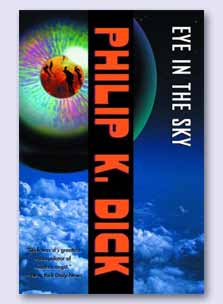
Eye in the Sky, by Philip K. Dick

At any given time I’m usually reading (at least) one book, and listening to an audiobook during my commute.  Sometimes I work on similar books for “reading” and “listening” at the same time, but most often I try to go down different paths with the two books.

Right now, I’m listening to Philip K. Dick’s The Eye in the Sky.

cov-eyesky-v-2001.jpg

It’s one of Dick’s earlier novels, in fact arguably the earliest one that really had that provocative Phildick quality. It was first published in 1957, and the super-quickie plot summary is as follows: Following an industrial lab accident, an out-of-work engineer finds himself, along with his wife and a few others, catapulted into an alternate world of Old Testament religious fundamentalism, where prayer and miracles and plagues of locusts are part of daily life.

Philip K. Dick is one of those writers I find interesting enough to think about and talk about, but I don’t actually find myself reading his work very often. I think he’s more notable for his ideas, for pushing the envelope and questioning assumptions, than for his actual writing. Certainly he’s a beloved name in the realm of science fiction, but he’s one of those writers whose books are more interesting in summary than they actually read on the page.

Still, I’d say he has a lot of value even as just a provocateur. And Dick was certainly one of the more interesting personalities or “characters” in science fiction when I was growing up, along with Harlan Ellison.

Speaking of Philip K. Dick, there’s a Dick biography by Lawrence Sutin that is one of the more interesting author bios I’ve ever read. It’s focused quite a bit on Dick’s late-life religious/metaphysical/psychotic experiences, hence the title Divine Invasions.

I’m no more than 1/4 of the way through this audiobook so I’ll write more about it later. Just wanted to write a little something about it, as I’m having fun revisiting a writer I think about a lot, and regard highly, but don’t actually read often enough.