Red Dragon and the Queen of Angels

I’ve seen the movie Silence of the Lambs many times, and the movie Manhunter once, but haven’t previously read any work by Thomas Harris. Manhunter is based on Harris’s third novel Red Dragon which was more recently re-made into a film of the same name starring Ed Norton.

I’m now listening to the audiobook of Red Dragon and I’m pretty impressed with it. Harris’s style is simple, kind of terse and unornamented, more of a gritty detective story than a horror story in terms of feel, but there are these incredibly hard-hitting and awful scenes of horror interspersed throughout. The horror feels real, though, not supernatural or make-believe. I haven’t enjoyed a new fiction author discovery as much since Robert Charles Wilson a few years ago, and I look forward to reading Harris’s later books, though I’ve heard Hannibal is not quite as good and Hannibal Rising is fairly questionable. OK, let’s just say I’m looking forward to finishing this one up, and then reading Silence of the Lambs.

Just recently finished Queen of Angels by Greg Bear and found it a challenging, thought-provoking piece of science fiction, quite different in style from the other Greg Bear works I’ve read. Though definitely a science fiction story, this one feels more literary and sort of poetic than his other stuff, though maybe closest to Blood Music. An interesting story focusing on distortions of the mind, and questions of consciousness and soul, both human and artificial. I’ll probably want to pick this up again in a year or two and go through it once more, as it’s fairly thick with ideas.

Star Trek Memories by William Shatner

This week I’ve been listening to an old audiobook I’ve had lying around for a long time which for some reason I’d postponed listening to, only to find it’s as interesting and entertaining as I could’ve hoped.

Star Trek Memories

The audiobook is read by The Shatner himself, and that would probably be enough to make it entertaining. But the book is full of interesting details of the lead-up to the production of the original Star Trek series, and varied reminiscences of Shatner and other cast and crew.

Shatner

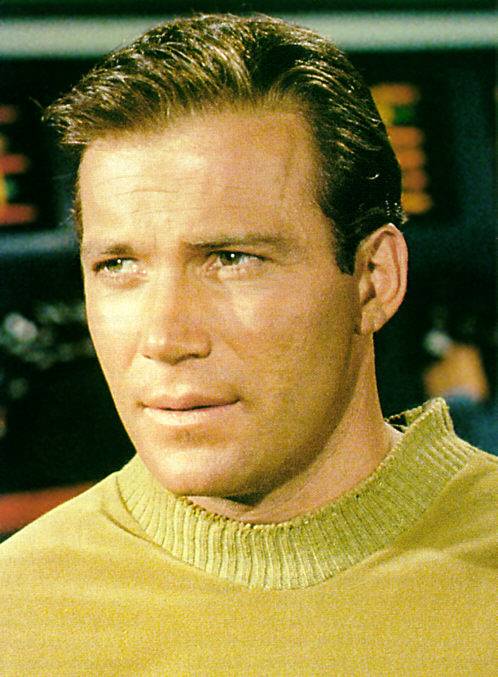
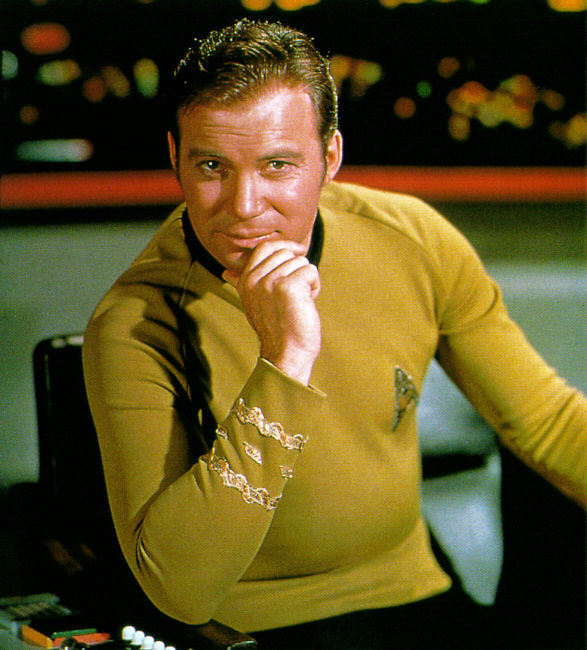
Did I mention that William Shatner is one of the coolest guys ever to have lived? Even if there had never been a Denny Crane, or a TJ Hooker, or the fantastic/funny/clever album, “Has Been,” he’s still Captain Kirk.

Has Been

I haven’t finished it, but have been having so much fun listening to all the stories of how the cast came together, how Gene Roddenberry dealt with production hurdles and studio annoyances, and how the actors and crew figured out how to portray the characters and design the sets and costumes and makeup.

So far, very highly recommended. It’s short, so I’ll be done soon.

Captain Kirk

Another Ridley Scott Alien

Wow, great news! Ridley Scott has signed on to do an Alien prequel!

More info here

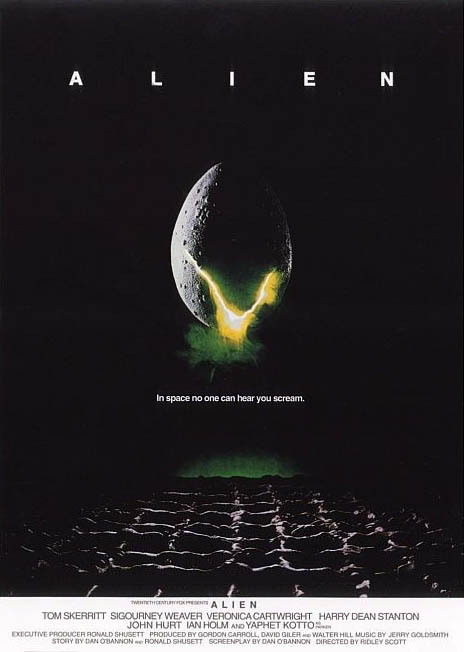
Alien poster
Alien poster

Scott directed only the original 1979 Alien film, and each of the 4 in the series have been made by different directors, but Ridley Scott is definitely the one of the four directors (Scott, James Cameron, David Fincher, and Jean-Pierre Jeunet) I’d most like to see try another Alien installment.

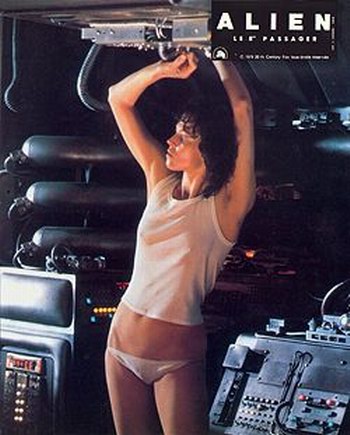
From what I’ve read, though, apparently no Sigourney Weaver as Ripley this time. Of course, she’s about to turn 60 and so running around in your panties no longer works quite like it did 30 years ago.

ripley

I’m almost as excited about this upcoming movie fun as about the two Hobbit movies coming up.

I haven’t bought a Kindle yet, and now…

I haven’t purchased a Kindle from Amazon, and given the various problems with DRM-related stumbles in how Amazon treats their own device, it’s not likely I will purchase one.

Kottke article on Kindle fiasco

The basic substance of the article is after a number of individuals purchased the Kindle versions of certain ebooks, Amazon magically deleted all the downloaded files from the Kindles of the customers. This was done due to some kind of rights dispute with the publisher, but it occurred without prior notification to the customers. Amazon refunded the money, but what does this say about the customer’s “ownership” of the product they’ve purchased, if the seller can just snatch it back, whether or not a refund is offered.

For an ebook reader to have any chance to catching on, it needs to not only be open to non-proprietary formats — in other words, you should be able to load your own .txt and .rtf and .pdf documents into it and read them, not just files you’ve purchased from a single provider — but it also needs to have a reasonable level of owner control over the content.

When you put an MP3 on your iPod, whether you ripped it from your own CD, or bought it from Apple’s iTunes store, it’s yours to keep. It never goes anywhere, and Apple doesn’t check in via some back door to make sure you haven’t loaded up, say, a bunch of mp3s you downloaded from bittorrent.

In other words, I’d say Amazon has handled their Kindle more like a Microsoft or a Sony, than like Apple. If Apple does release its own competitor to the Kindle (a larger screen iPod Touch, or iPhone, or the rumored tablet computer), Amazon will be in trouble.

Words Out: A New Hope

Most of these blog entries have been about books I’ve read recently, or crazy authors I’ve enjoyed, but my earlier-this-week blog entry “Words in, words out” said a bit about my own writing, at least the earlier stage of that.

So when we left off, I had left off my own fiction writing between the time I was almost thirty, and more recently (I’m forty-three now) when I’d decided I was interested in picking it back up.

I didn’t just grab a pen and paper, or computer word process, and get started spewing words. I spent quite a bit of time daydreaming and planning, re-reading some of my earlier work, and thinking about what kind of work I felt motivated to create. Those early stories (and novels and poems) were mostly straight “literary” fiction, that is, stories about people being serious, joking around, relating to each other, and… feeling ways about stuff. Some of them, the ones that remained interesting to me, were more experimental, or looked at reality through a different lens.
pen-paper

I thought about the books and stories I’d most enjoyed reading, simply as a reader, not as a writer comparing himself or looking for inspiration. Then I considered, aside from what I most enjoyed as a spectator of good writing, what sort of stories would it excite me to create?

I realized I wanted to create new worlds, different worlds from this real one, not only different in the sense of having imagined people in them, walking around and worrying about concerns exactly like the concerns of the people in this real world. I mean entirely different worlds, different concerns, different rules. I want to imagine wider possibilities. It excites me to imagine a future in which our world is different, things have changed in ways that are sometimes shocking, at least interesting.

In the end I decided I can write whatever I want but I also need to consider what kind of “markets” (a really seedy and overly commercial-sounding word, to most people, but one writers throw about and mean nothing worse by it than “places I might send my stories) to consider. That means slotting the work a genre and I guess I’d say we’re talking about Science Fiction here.

Dune

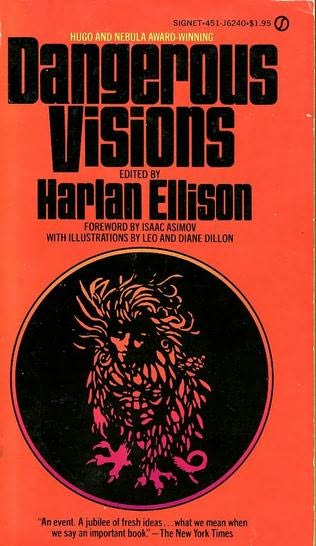
Now, the irritating ass-hole voice in the back of my mind complained a little bit. I mean the arrogant jerk who majored in Literature (big “L”) in college, and who, despite really loving Harlan Ellison and Frank Herbert and assorted others, still kinda felt like Science Fiction was a sort of less-serious, less-literary genre. This discussion has come up a few times before, on the Hypnos Forum (a discussion board related to my record label, Hypnos Recordings) where there are many sci-fi fans including one who’s an editor at Asimov’s. This came up before I was writing, and I was acknowledging that voice in the back of my own mind when it came to the regard of science fiction from a reader’s point of view, not as a writer. But I can’t help think back to it, and halfway try to talk myself out of getting involved in it, knowing that the little condescending, snobby voice is there in the back of my head.
Dangerous Visions

In the end, I decided the little voice can just get over itself, and I will follow what my gut tells me is right. The truth is, I get as excited about a good new science fiction movie as about any other kind of movie. Most of my favorite TV shows (Battlestar Galactica, Firefly, Star Trek, etc.) are science fiction. More and more, when I think about reading a book for pure enjoyment, I think of something like Greg Bear or Gregory Benford, or more recently Robert J. Sawyer or Stephen Baxter or especially Robert Charles Wilson. I’ve recently become infatuated with Greg Egan, only to find that at times his books are infuriatingly, willfully unfriendly to the reader… but I’m as excited to explore the rest of his work as I am about any other writer I can think of.

Spin

Undoubtedly I’ll write some things that sci-fi purists may look at and say “Hmm, not enough spaceships,” and I’ll have to figure out what to do with some of my stories. But when the first subjects I want to write about include artificial intelligence and robotics and life extension and simulated reality, and the environments I want to explore include the future Earth, outer space, and other planets, I become increasingly comfortable just settling into that genre and starting to explore.

I’ve written about fifteen stories in a very short time, some just a first draft, and a couple of them nearly finished. I’ve plotted out a connected story cycle, begun to lay-out one novel, and made notes toward a few other novel ideas. I’m writing better, more quickly, and with greater pleasure than at any time before, and I feel I’ve just started again. The things I’m writing now are more considered, more mature, and certainly more geared toward a readership outside of my own brain, than what I did when I was younger. I like the idea of having stories published at some point, but I’m also enjoying the process of getting the words out and then carefully re-working and polishing them, so I won’t hurry the whole “publication chase” aspect. It seems to me that if the writing is good, then the possibility of getting things into magazines will follow. I think it is a real flaw of many writers, certainly was a flaw of mine when I was younger, to push the whole “must get published, must get published!” overdrive with much greater energy and priority than what SHOULD be one’s primary motive, “must get better, must do the best work possible.”

Before too long I’ll start to be more specific about some of the things I’m working on and planning, and may even post a little word-blurb excerpt of actual written fiction, at some point. But the above gets us up to date, as far as the whole “Words Out” side of things.

We want our artists to be crazy

Last week I read an interview with Thomas Ligotti (who, in case you don’t know, if a very interesting, uncompromising and very strange writer of psychological horror fiction. I’d read about Ligotti before, but in the course of reading this interview I realized a very high percentage of the creative people I’ve admired are somewhere between “troubled” and “completely nuts.”

Just look at who else I’ve written about in this short-lived blog… Hemingway (suicidal alcoholic), Fitzgerald (depressive alcoholic), Philip K. Dick (who, let’s just say, has a five paragraph section under the heading “mental health” in his Wikipedia entry), and now Ligotti. For a catalog of Ligotti’s psychological troubles I’ll leave you to read the above-linked article, if you’re interested.

Add to that list some of my other favorite creative inspirations, for example painters –Jackson Pollock, Mark Rothko, Salvador Dali, Andy Warhol, Frida Kahlo — and a pattern begins to emerge. One begins to wonder, do individuals of the sensitive nature who might excel at creation just naturally have a hard time in life due to that sensitivity? Or is it that unbalanced, obsessive people have more time or energy to focus upon their creative work, and are thus more likely to be productive and to succeed? Or is there something in the inward searching all creative artists must undertake that is somehow troubling or corrosive to one’s happiness in the long term?

I really don’t know the answer to this. It does seem, though, that a quick rundown of my list of favorite poets, artists, composers and so on, yields a rate of incidence of psychological problems greater than what’s seen in the general population.

Words in, words out

When I started this blog it was not only to talk about things I’m reading, but also my own writing… but that’s an aspect I haven’t written about at all, yet, in this space.

So, a quick recap for those of you who don’t know who I am, or only know me through the electronic music “M. Griffin,” or know me personally but didn’t know I was into writing fiction.

I was a Lit major in college, at University of Oregon in the 80s. During that time, when I wasn’t worshipping at the Ernest Hemingway altar in my off-campus apartment, or hanging around with my Zelda Fitzgerald-like girlfriend of that year, I was experimenting with words, writing weird poetry, even weirder one-act surrealist plays, and gradually a bit of short fiction. My last year, I set myself the goal of writing a novel before I graduated. I did complete an angst-ridden, rather immature novel called Bright Fever, but it was more of an exercise than a serious attempt to write something that might be published, and I never even seriously considered sending it out.

After college I became more serious about short stories and wrote a couple dozen terse, minimalistic stories that I sent out to magazines without much luck (only one short fragment published in Missisippi Review), and took a couple of slightly more ambitious attempts at the novel.

Some time in my late twenties, while living in Seattle, I wrote another angst-ridden and rather immature novel called Hum. This one was a lot more interesting, getting into territory that might be called metaphysical or surrealist, having to do with a protagonist who learns how to “shift” reality slightly so that he’s able to exit out of the world inhabited by other people, and move about in a differently-shaded version of the Seattle he knows, but with virtually all the people gone.

Hum never went anywhere (again, didn’t send it out to any publishers or agents or really anybody outside my household), but it remains a concept I’d like to revisit and possibly incorporate into a more broad and complex idea I’ve had. So there may be more discussion of that title here in the future.

Not long after that, I moved back to Portland and entered a 3-day Novel contest, and one Memorial Day weekend sat down with two cases of Coca Cola and wrote, from two pages of notes, a short novel called House of Longest Days. I had originally planned a story by that title about people who inhabit a house that allows them to live in a young, carefree and surrounded-by-friends state forever, but this concept was somewhat more normal than original plan. It ended up being a story about a handful of former college friends retreating to the large home of one wealthy friend (does it sound like The Big Chill yet?) and sort of catching up on each other, realizing how different they’ve all become, and airing all their unresolved bullshit. It’s actually much less like The Big Chill than my synopsis makes it sound, and much stranger… the basement of the house has a number of secret or semi-secret “theme” rooms into which people disappear for little adventures (the room of fire, the room of color, the pillow room, etc.) This one was, finally, sent off to be read by people unrelated to me. My third novel did not win the contest, but I didn’t expect it would.

Big Chill

I continued with the short stories for a while, and became a bit more ambitious, and a bit less terse and minimal (communing just as often with the spirit of Fitzgerald as Hemingway), though I had also discovered Raymond Carver by that time and become obsessed by him, so who knows.

Then I was about to turn thirty, and went through a really awful breakup after which I took a break from writing. I figured I would pick up again (and I even have some notes and outlines I put on paper during the “not writing for a while” stage) but I became involved in ambient music, started recording my own material, started my record label and became too busy with that to work on any of the other creative activities I’d previously enjoyed.

Somehow I always knew that I would find my way back to writing fiction, and I hoped that my new “life experience” and maturity would allow me to be more brutally honest and self-critical when I resumed writing again.

Fast forward, now, twelve years or so.

I was married a couple of years ago to a fantastic woman named Lena who is very supportive and encouraging of all my creative urges and endeavors. At some point she gave voice to an idea that I’d heard in my head a few times, which was that despite all the time I spend on electronic music, and various other art forms, what I’m really “meant” to do is write. So I chewed on this for a while, and last year I had a feeling that it was time to go through some of my earlier writing and think about it.

I came away from that rearward glimpse both encouraged and discouraged. On one hand, some of the writing I had revisited was very good, by some measures. A lot of the language, the scenery and descriptive stuff, and the dialogue in particular, had some very fine moments. On the other hand, most of the stories were more vignettes than actual stories. Those that had at least some hint of plot, didn’t have much development. In the end my assessment was that this young writer had some skill and some promise but he needed to grow the hell up, and start thinking less about his own poetic convolutions, and give more consideration to the experience of the reader.

I will save for another post (soon, probably) the story of how I actually began writing again, how it went, how it’s going, and what I hope may become of it.

Picking this back up again

Probably 99.99995% of new blogs never make it fast the initial few posts, I’m sure. I never quite established the habit of visiting here every day, and sort of forgot about it, but I’m going to take another stab at posting here.

The purpose of this blog, as I said at the beginning, is to talk a bit about my own recent writing and reading (and I include audiobook listening when I say “reading”).

So, to quickly catch up from where I left off, halfway through Eye in the Sky

The second half of that early Philip K. Dick novel was slightly better than the first. As I haven’t read a Dick novel since probably the late 80s, this has got me thinking, “Is he just one of those writers that’s better in theory than in reality?” I mean, his concepts are interesting, but the writing…

On the other hand, this is an early book of his, certainly not considered one of his better works. So I’ll just set it aside, and certainly NOT be in a hurry to read Dr. Futurity or Solar Lottery any time soon.

At some point, I’ll give another look at one of the books from his last decade.

I’ll keep this short, and try to make shorter, less ambitious posts in the future (at least until I establish a routine of posting here) so I’ll be more likely to keep posting regularly. I’m sure this blog’s many readers are saying in unison, “Sounds great, Griffin!”

More Dick

OK, I’m somewhere past the halfway point of Eye in the Sky, the Philip K. Dick audiobook I’ve been listening to. I said before that I felt Phil Dick was more of an “idea guy” than a prose stylist and that has only been reinforced by this book.

Yes, his writing became more sophisticated and careful later in his career, and I suspect these early novels of his were written in a quick rush of a week or two, just for the money. But still, the quality of the writing is very poor. Sentence after sentence follows precisely the same template.

“Flinching wildly, she set the glass down on the table…”

“Ducking suddenly, he turned to his wife and said…”

“Blinking incredulously, Hamilton tried to think of the right words…”

Almost very sentence starts with someone verbing something adverbially. Ugh. It becomes pretty distracting after a while.

Reading and listening

Yesterday’s post about Eye in the Sky reminded me of a subject that interests me, which is the difference between reading a book on paper, and listening to an audiobook.

I certainly wouldn’t say the audiobook experience is the same as, or even equivalent to, the experience of reading words on a page. There’s a difference for sure, a difference in how the information is received by the reader or listener’s brain. I’d say one’s attention is more likely to drift while listening, especially if you’re listening while driving or riding the bus, than while you’re reading a book, especially if you’re reading while relatively undisturbed. For that reason there are certain kinds of books — instructional material, or literature with a strongly poetic, ornate style — that I wouldn’t try to listen to, as opposed to reading.

Audiobooks are great for straightforward non-fiction like biographies, or for fiction in the realm of Stephen King, Anne Rice, or Tom Clancy.

Another difference between the two is that with audiobooks, the quality of the reader (I mean, the voice actor doing the reading of the book for the recording) makes such a huge difference in how it comes across. I listened to a Harlan Ellison reading of Ursula LeGuin’s first Earthsea book, and Ellison’s silly voice antics completely ruined it. Likewise, Stephen King reading one of his own Dark Tower books was very distracting. Other readers, like John Slattery who read Stephen King’s Duma Key, do a great job conveying difference voice qualities for different characters’ dialog, and also manage to spit out the words of complex sentences in a way that helps you decode them while you listen. With poorly-read books I often get the impression that the reader didn’t really know how to parse the sentence and was just speaking the words in sequence, without emphasis.

Before I started reading audiobooks, I always looked down my nose at the. I considered them kind of a half-assed way to consume a book, a reading alternative for semi-literates. Now, especially since I have a fairly long commute, and since I have nowhere near as much real reading time as I would like, I very much value the extra “story time.”