Review Backlog… Yes, I Know!

There are many, many books i have finished reading and not yet reviewed. This is no big deal if it’s just a book I bought and read, and figured I might as well review, but I feel kind of bad about it if I asked for a review copy, only to drag my ass in producing a review.

In many cases the reviews are partly written and just need to be polished a bit. In other cases I have notes, and even creating a brief review from existing notes is pretty easy.

I’ve read so many great books in the past year or so, especially story collections, and my to-be-read pile still tempts me with a mountain of other cool stuff. My plan is to start finishing and posting 1-2 new reviews a week until I’ve caught up.

Words In: The Last Final Girl by Stephen Graham Jones

Told at the full-tilt pace of a teen slasher pic, The Last Final Girl by Stephen Graham Jones effectively conveys the author’s love and respect for the form. Divided up into very short bites, like a movie is divided into shots of a few seconds each, the story proceeds at a rapid clip, with none of the typical novel’s digressions or introspection. It’s something like 90% dialog, interspersed with tags almost like shorthand, describing character actions.

The slasher is probably one of the most straight-forward, accessible kinds of movies, but this book is told in an experimental style. Others have likened the format to a screenplay, but it’s actually more like an overseeing narrator describing the on-screen action of a film as it happens. It’s a verbal play-by-play, describing shots, character movements, what the camera (and audience) sees and notices. The narrator is well-versed in the actors, directors, references, inside jokes and tropes of slasher films.

The Last Final Girl by Stephan Graham Jones

This results in a fun, cheeky stream-of-consciousness running description, complete with winking asides from the characters and sometimes also the invisible narrator letting the reader in on any references they might’ve missed. Though the story takes place in the present day, these high school kids are very familiar with cultural touchstones of the 80s (the golden age of the slasher film, as well as the coming-of-age era of the author) so that lines from popular movies and other culture from my own high school years pop up all through the story.

In a sense this is less about literature, in the sense of inward reflection, and more about the kinetic energy of film told in written form. It’s clever, full of attitude, crafted by a person who clearly loves, values and understands slasher films as a genre. The Last Final Girl is a good-natured, energetic gonzo tale, full of winking references, name-dropping and a non-stop barrage of self-reflexive acknowledgment that Jones is in on the joke and he’s enjoying himself in the writing every bit as much as any reader.

Words In: Ink by Damien Walters Grintalis

Ink is the first published novel of Damien Walters Grintalis. In the past year or so I’ve enjoyed a number of beautiful short stories by Grintalis, most characterized by an especially lush and vivid quality to the language. Though I’m often reluctant to take a chance on first novels, as they’re so often flawed in terms of structure and pacing, her short fiction convinced me Ink would be worth a try.

ink

It’s the story of Jason Harford, a young man devastated after having been left by his wife just before the novel begins. He sets out to soothe the pain of rejection, telling himself he’s celebrating his newfound autonomy by doing things his controlling ex-wife never would’ve permitted. He gets drunk in a bar, and acquiesces to a stranger’s suggestion that he should get a tattoo. The tattoo artist, a crusty and uncomfortably menacing old guy Jason calls “Sailor,” asks Jason to sign a liability waiver before he proceeds. Jason starts to wonder what he’s gotten himself into, but the resulting tattoo of a griffin is beautiful, exactly what he wants. It impresses his friends, even leads to a hookup with an attractive young lady named Mitch, who also happens to have a griffin tattoo.

Jason starts to think he’s dodged the worst of the pain of being rejected by his wife. A cool new tattoo, more time to spend with his friends, even a cute young lady who fell into his lap, and seems really into him. Maybe things will turn out better for Jason, not worse… right?

Most readers will have guessed that the significance of Jason’s tattoo goes more than skin deep. The name of the book, and the sinister nature of the tattoo artist (real name John S. Iblis) should make clear there’s a price to pay, a reversal to come. The tattoo isn’t quite what it seemed, and Jason hasn’t seen the last of “Sailor.”

Many writers whose short fiction is especially poetic or stylized often take a simpler approach when working at novel length, and that’s the case here. The writing is deft and effective, with a straight-ahead style of minimal adornment, a focus on clarity. There’s never any question what’s happening, or why a character is doing what they are — both frequent problems in first novels. The story is engaging from chapter one, and moves briskly through to the end without faltering or getting side-tracked.

Grintalis is certainly an emerging writer worth keeping an eye on. I’d love to see her approach the novel form using the more poetic, almost ornamented style of language of some of her short stories. In any case, Ink is a successful and most promising debut novel.

Words In: Knock Knock by S.P. Miskowski

Knock Knock, a novel by S. P. Miskowski, follows a trio of girls, from the town of Skillute in western Washington state. We’re introduced to Marietta, Ethel and Beverley at age eleven, follow their lives as they grow up to womanhood, see their connections to each other evolve and shift as the events of life and adulthood affect them individually and together. The girls hear horrible rumors of what happens to women who become pregnant, and resolve that this will never happen to them.

Knock Knock

Marietta lives with her aunt Delphine, who is something like the town mystic, herbalist and fortune-teller, and has an idea of a spell the girls might perform in order to ensure they’re never burdened with motherhood. They find a remote, seemingly spot in the woods to perform the ritual, despite Skillute area legend that “Miss Knocks” lives in the forest and will chase children and possibly snatch them away. The discovery of strange bones half-buried in the wild, combined with the tales of Miss Knocks, leaves the girls more frightened of the woods and their own weird, occult-like ritual, than of the fear of eventual pregnancy which drove them out there in the first place.

All three girls remember that day. The memories have a different effect on each, with the passing of time. Miskowski examines the way fear of legends affects the living, not only in terms of the actual manifest “powers” of the force of legend, but also by the way our fear shifts us, opens us up to risks, and closes off possibilities.

We revisit the trio as they age, learn more about their family backgrounds, and see how they fit into their community. The familiarity of the settings and seeming normalcy of the characters heighten the effect of disquiet and strangeness when horrific elements intrude. Miskowski’s strength is in the naturalistic depiction of characters and real-life events and settings, which is not to say she lacks skill in depicting the horrific or supernatural elements. It’s that vibrantly lifelike sense of observing real human beings as their lives pass from the normal to the strange that heightens the effect of fear and unease when it occurs.

Knock Knock creeps up on the reader slowly, without flashy effects or a fast pace. I was won over by Miskowski’s believable characters, and the realistic depiction of a supernatural intrusion into small town life. Miskowski has announced a forthcoming series of novellas based on this place and set of characters, the first of which is Delphine Dodd. The darkly effective creepiness Knock Knock is enough to make me want to see what more she does with the Skillute milieu. Recommended, especially for readers who favor suspenseful, slow-building psychological horror.

Words In: In the Mean Time by Paul Tremblay

I first saw Paul Tremblay’s name mentioned in the blogs of several other writers I enjoy, so it should be no surprise that I enjoy the fictional worlds he creates. I love the way Tremblay balances strange and playful elements against emotional realism and seriousness. These stories take chances, but never leave the reader behind in pursuit of writerly flourishes or abstractions.

In the Mean Time

The bulk of the collection is comprised of whimsical yet dark pieces existing in a sort of no-man’s-land between genre fantasy, thinking person’s horror and the absurdist-realist balancing act of Aimee Bender or Donald Barthelme. Think “weird fiction” in the modernist sense, rather than Weird Tales or Lovecraft. Many of these stories would be as much at home in the New Yorker as a genre periodical, though the oddity and off-kilter of Tremblay’s work will certainly please readers geared toward the fantastic or the dark.

Earlier pieces address birth, childhood and youth, as in the memorable “The Teacher,” where a class full of kids follow a teacher to cult-like extremes in pursuit of a difficult lesson, or “It’s Against the Law to Feed the Ducks,” which depicts a strange family vacation full of delusion and deception. In the middle are a few slight pieces, more like vignettes than stories, but later on the collection moves on to address post-apocalypse or “breakdown of society” scenarios, in every case without explaining what happened, or how. “We Will Never Live in the Castle,” in which characters try to survive in an a disintegrating amusement park, is a highlight.

Though often weirdly troubling, Tremblay’s tales are direct in the telling, emotionally honest and straightforward enough to be easily understood. By turns funny, shocking, disturbing, touching, often all the above in the space of a single story, In the Mean Time leaves me extremely impressed by Tremblay’s craft and his intelligence. I highly recommended this adventurous and marvelously weird collection.

Words In: A Pretty Mouth by Molly Tanzer

Molly Tanzer’s A Pretty Mouth is so much damn fun! Tanzer runs through a variety of modes, from amusement to historical drama, and from playful smut to occult mystery. Tremendously entertaining throughout, the four stories and short novel form a linked sequence examining a strange family’s centuries-long history. Each installment follows a different pair of Calipash twins (the family’s children always arrive in twinned pairs) in various historical eras. This thread binds the stories into an almost novelistic whole, while the shifts in time and setting gives Tanzer a chance to play around with literary influences and try out storytelling flavors.

aprettymouth

These commence with the Wodehouse-inspired lead-off, “A Spotted Trouble at Dolor-on-the Downs,” a charming, funny and inventive mashup. Tanzer doesn’t just riff on Wodehouse’s style or flavor. Bertie Wooster and his valet Jeeves actually appear, and end up mixed in a “high society meets secret society” tale with a strong Lovecraftian flavor.

“The Hour of the Tortoise” is a gothic tale about Chelone, herself a writer of gothic fiction, whose life and stories frequently intertwine. The third piece, “The Infernal History of the Ivybridge Twins,” appeared in the Historical Lovecraft anthology and was reprinted in the first Book of Cthulhu, so will be familiar to some readers of Lovecraftian anthologies.

The long novella which gives the book its title follows 17th century university boys seeking entertainment and getting into mischief. Gradually the Calipash influence exposes young Henry Milliner to a world of gradually revealed debauchery, mystery and secrecy. In the finale, the Roman era setting of “Damnatio Memoriae” shows how far back the Calipash line extends, and reveals something about the nature of the family’s curse. As a self-contained story it may be the least compelling in the book, but its presence is justified as a sort of origin tale, shedding light upon the rest.

In addition to the oft-mentioned influences of Wodehouse, Edward Gorey and Aubrey Beardsley, I found much of A Pretty Mouth reminiscent of the zany-sexy-scary-funny cinema of the late Ken Russell, such as Lair of the White Worm or Salome’s Last Dance. Overall, this is a crazy book — that is, a giddy sort of crazy, where the reader sees early on it’s not just random silliness, but guided by a great inventive intelligence.

In an era when most emerging authors seek only to chase the latest market trend, Tanzer does something completely, strangely different. This book’s charm derives from the way she successfully strikes such a wide range of notes. It’s charming, intelligent and cleverly crafted, a sure sign we’re in for many fresh and memorable things from Molly Tanzer in the future. Overall, A Pretty Mouth is one of the better debut collections of recent years, and certainly one of the most distinctive.

Words In: Best Horror of the Year, v.4, Edited by Ellen Datlow

This is Ellen Datlow’s fourth time editing Best Horror of the Year for Night Shade Books. This edition is the best so far, combining potent, ambitious longer works by genre stars with a varied sampler of up and coming names. Eighteen stories (including several novellas) follow Datlow’s lengthy introduction, a wide-ranging summary of the genre year touching on noteworthy novels, anthologies, collections, periodicals, awards and events. If the tasting menu of the year’s finest short fiction weren’t enough to make the volume an essential overview of all things noteworthy in the horror genre, this overview tips the balance. This makes an excellent introduction to talented new writers, as well as others more established who may yet be unfamiliar to a given reader.

BestHorror_v4_Build_01.indd

For example, I knew David Nickel and Brian Hodge by name, but hadn’t read their works, which turned out to constitute pleasant revelations. In Nickle’s “Looker,” a drunk man at a party finds a woman whose qualities go beyond the merely eye-pleasing. In “Roots and All,” Hodge’s character revisits a town where important childhood events occurred, some of which still echo in the present. Both stories exemplify Datlow’s preference for character-driven horror, more haunting mood and troubling memory than blood and shrieking monsters. There are several more standouts:

“Blackwood’s Baby,” like many Laird Barron stories, takes place in rural Washington state, and expands upon Barron’s personal, regional mythos. This novella tracks a 1930s expedition of diverse hunters seeking a beast of legend more dangerous than any of them anticipate. It’s as powerful as any previous work by Barron, who lately can be counted upon to contribute at least one rich and potent tale to each year’s best.

In Livia Llewellyn’s “Omphalos,” a girl caught in terrible surroundings must fight complex factors keeping her in place. Llewellyn specializes in the dark, raw-edge and harrowing. Her writing pulses with blood and seethes with emotion. Her “Engines of Desire” is among the best weird/dark collections of recent years, certainly one of the top debuts.

In John Langan’s “In Paris, in the Mouth of Kronos,” two fallen former agents try to claw their way back to gainful employment. They’re hired to grab a “Mr. White,” who may be a very different order of being from what they expect. Dark yet breezily entertaining, merging the grittiness of noir and spy thriller intrigue with a Lovecraftian hint of ancient forces lurking beneath the everyday world’s seeming normalcy. Langan’s a skilled writer, whose work Datlow often features. At times I’ve thought his work needed more of an edge. This has it.

“The Ballad of Ballard and Sandrine” by Peter Straub is a tour-de-force of tender yet bitter codependent romance conveyed in a disorienting balance of straight realism and twisted surrealism. In a series of encounters separated by wide gaps of time, the title characters (the much older Ballard is a mysterious “fixer” type employed by Sandrine’s father) journey down the Amazon River on boats with ever-changing names. The couple, caught up in unfathomable events, exhibit a muted curiosity about their circumstances. At times they make experimental gestures seeking to understand the odd nature of the boat or its invisible crew. What knowledge they gain always seems to be lost, forgotten or clouded by the next interlude. The effect is weirdly disorienting, yet familiar. Don’t we all forget lessons we’ve learned, ignore warning signs, and often repeat our mistakes? The growing surreality of Ballard and Sandrine’s circumstances finally unfolds at least partially. Horrific and seemingly occult aspects are revealed, yet mystery remains. Straub may be the most cerebral of horror writers, and this is one of his best, boldest works.

Words In: Urn and Willow by Scott Thomas

Urn and Willow by Scott Thomas (Dark Regions Press) is a collection of short supernatural tales. The quiet, reserved style stands in dramatic contrast to the high intensity characteristic of much recent horror fiction. Urn and Willow has the feel and the scent of the worn and tattered volumes the reader discovers on a grandparent’s dusty bookshelf in childhood, strongly historical in orientation, and old-fashioned in both tone and setting. Pick up this book and read a few stories without first checking the publication date, and you might reasonably guess it had been published 75 years ago. The nostalgic quality of this collection arises not only from the date settings, but from the style of language and the very sensibility of the depicted worlds. By the end, there’s no doubt: Scott Thomas is obsessed with a given era and locale.

urnwillow

These simple little stories are almost delicate in their restraint and subtlety. This antique or old-fashioned quality is not mere backdrop. Supernatural things happen — ghosts appear, the dead walk, unexplained events manifest — yet much of the book’s purpose seems to be the careful rendering of rural New England, mostly in the early 19th century. Much as the stories focus on hauntings and supernatural mysteries, they’re equally about the loving depiction of an earlier place and time. Close attention is given to details of nature, home and land. We observe interactions and customs in tiny villages and get a sense of a simple, almost puritan approach to daily living.

A few of the longer stories stood out as more modern in approach, despite settings similar to the rest. In “The Bronze-Colored Horse,” one neighbor after another is victimized overnight by a terrible affliction. Investigation leads to the discovery of creatures from a surreal and terrifying dream. “The Seed of Increase Severance” likewise utilizes disturbing nightmarish imagery to tell a story that crosses multiple generations. “Miss Smallwood’s Student” tells of a tutor’s attempt to teach a very unusual young girl. In “The Company of Others,” an occultist hires an artist to paint a landscape mural in his home, and by occult ritual summons odd creatures who then share his home. These more ambitious stories, modern in approach if not setting, hint at Thomas’s ability to satisfy in a more adventurous, less conservative mode when so inclined.

The rest of the stories are unified by simplicity, brevity (most only 4-8 pages) and a throwback approach to depicting the supernatural. In these cases, the mere revelation of a disturbing event is enough. There is no twist, no gut-punch. To some readers, this is comfort food, difficult to come by these days. Scott Thomas is one of the few present-day writers serving up this sort of fare, and he does it with a deft, assured touch. This is a supernatural horror of chill and disquiet, not violence or extremity. Readers seeking the cutting-edge may find Thomas’s work too subdued, but those who enjoy the restrained approach of yesteryear will find much to appreciate. The book is redolent of a slower, simpler world. With Thomas’s polished and confident style, Urn and Willow vividly evokes another time and place.

Words In: A Season in Carcosa, Edited by Joseph S. Pulver Sr.

This is one of the most significant multi-author anthologies of recent years. A wonderful, concentrated batch of intoxicating goodness, sure to please readers of weird fiction and horror.

Season in Carcosa

Every anthology includes pieces that don’t work for all readers. All too often, the reader must be satisfied with just a few strong stories in the mix. In this case, the intelligent and provocative bullseyes greatly outnumber the few misses. Some of the highlights come from reliable writers such as Laird Barron and John Langan, who lately seem never to miss the mark. Both use the “King in Yellow” theme as an excuse to try something a little different, to veer off the path of their usual focuses and themes. Barron does something that feels much like veiled biography, in which a Carcosan entity visits an author who seems clearly inspired by Karl Edward Wagner. Langan’s tale has the feel of nightmare, and follows an actress as she stumbles through an extraordinary soundstage during the filming of a project seemingly attuned to a world other than our own.

The greatest anthologies are important because they do more than just parade one famous author after another; they bring to the reader’s attention work by less familiar names. I’d never read anything by Gary McMahon before, but his Bukowski-inflected noir, “it sees me when I’m not looking,” was a wonderful surprise. Edward Morris comes up with a surreal and disturbing tour de force, “The Theater and its Double.” This complex and ambitious piece blends poetry, screenplay, and stream of consciousness.

Favorites here include Allyson Byrd’s “The Beat Hotel,” an atmospheric, art-flavored 60s-in-Paris wonder that hit this reader’s sweet spot, and Cody Goodfellow’s extravaganza of mental illness, drugs, dark ritual and mind control, all with a children’s television backdrop, “Golden Class.” Other standouts included stories by Daniel Mills, Pulver, Strantzas, Richard Lupoff and Joel Lane. As often happens in tribute anthologies, the most successful stories went beyond mere emulation and instead used an author or story’s themes to do something in the writer’s own style.

Themed short fiction anthologies roll out into the marketplace too quickly for any reader to keep up. In any given year, there are a few standouts worth every genre reader’s time. A Season in Carcosa is one of those special few deserving of wider attention.

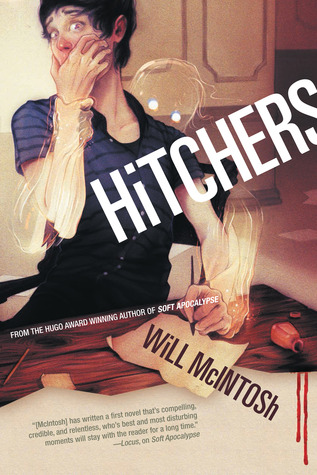
Words In: Hitchers by Will McIntosh

On a single day at the beginning of Will McIntosh’s Hitchers (Night Shade Books), cartoonist Finn Darby loses both his wife Lorena and his elderly grandfather, who 40 years earlier created the successful comic strip Toy Shop. The grandfather previously made clear his refusal to allow Finn to take over the strip after his own death, but as it turns out, Finn easily convinces his grandmother that continuing the strip will benefit them both. Finn keeps “Top Shop” running, introduces new characters, and signs licensing deals, and these changes bring popularity, fame and wealth.

Hitchers_Press_rv01.indd

When a major terrorist attack strikes Finn’s home city of Atlanta, the half-million sudden deaths bring about the novel’s premise: Spirits of the recent dead take over the bodies of the living. These “hitchers” appear first through verbalization, then gradually control the bodies of their living hosts. The novel’s emotional impact is strongly front-loaded. Events pile up fast in the first few chapters. Along with a few characters entangled with him, Finn seeks to understand what’s happening, then manage the interference of these “hitchers” as the influence they exert over the living increases. Finn partners with Mick Mercury, washed-up 80s rock star, and waitress Summer Locker, who Finn and his wife encountered just before Lorena died.

McIntosh presses the story relentlessly forward, in a straightforward, unadorned style, with brief scenes and chapters. Characters move briskly from place to place, event to event. The overall tone remains breezy, despite a brief serious turn in the early going as characters adjust to the loss of loved ones, and greater Atlanta copes with mass death. These scenes are affecting, and come across as “real” in a human way. McIntosh conveys Finn’s conflict between a selfish desire to control “Toy Shop” and an impulse to respect his grandfather’s wishes.

As events progress, the story unfolds at double-speed so that the last half of the book seems compressed. The reader glides along the surface at an increasingly superficial level. Significant story milestones fly past, and the plot jumps forward, more synopsis than narrative. A long-developed romantic triangle is resolved in just a sentence or two. A character’s mindset suddenly jumps from problem-solving to giving up all hope, without much in the way of transition. These plot turns feel less true, less emotionally justified than what came before.

Just when the plot seems to be on a rail headed toward inevitability, McIntosh pulls out some rewarding surprises and nicely resolves the ending. Hitchers offers an interesting setup and likable characters whose conflicts and drives compel the reader. Despite pacing issues in the second half, it’s an enjoyable and entertaining read.