Words In: Fugue State by Brian Evenson

The first time I remember hearing the term “fugue state” was in association with the David Lynch film Lost Highway, in which a character detaches psychologically from life he knows, loses his very self. He drifts on through life, encountering strangers who are vaguely familiar, and tripping over circumstances which seem tenuously related to the life and self-hood he knew before.

I don’t know how much Brian Evenson was inspired by Lynch’s film, if at all. The characters in Fugue State encounter mysteries, and in most cases undergo some kind of shift or dislocation of personality. Sometimes the characters are lost, while the reader is allowed insight into the character’s plight, and at other times the reader is equally mystified. This obliqueness is intentional, not a matter of poor craft, of stories lacking somehow. When an author gives the reader such a large helping of absurdity, of disconnection and illogic, the reader must determine whether the effects are in the service of a coherent artistic intention, or if the storyteller is himself lost, or just goofing around. Evenson’s stories always convey not only willful intention, but consummate craft.

There may be no more than a thin line between the pointlessly nonsensical and the profoundly obscure, or resonantly absurd. Storytellers like Kafka and Borges, not to mention David Lynch, manage to test the limits of what their audience may consider meaningful without every straying over that aforementioned line.

These stories vary dramatically in length, from 2-page snippets to the 30-page title novella. Fugue State straddles the boundary between experimental literary fiction and genres such as weird fantasy, horror and slipstream. The writing here has the flavor of edgy-yet-mainstream literature, but in these stories weird things occur as in Poe, Kafka and the like. Just as with the other authors I’ve mentioned by name, Brian Evenson’s work is not for everyone. These mysterious and intelligent fictions don’t always give answers, but rather stimulate some hidden, unknowable aspect of the subconscious. Those who like this kind of thing – Kafka, Borges, even David Lynch’s Lost Highway or Mulholland Drive – will love Fugue State. I recommend it highly.

Words In: Available Dark by Elizabeth Hand

Available Dark follows Cassandra Neary, a damaged, self-destructive and somewhat washed-up art photographer, who first appeared in Hand’s 2007 novel, Generation Loss. A novel with Neary as a protagonist is bound to be a wild ride. She’s prone to sudden changes in direction, abruptly taking off for an isolated island off of Maine (in Generation Loss), or to meet a shady Finnish collector of death-obsessed photographs, or chase a long-lost friend/lover who might be in Iceland. Along the way she encounters murder and threat, and often manages to multiply her own troubles by the following her own badly damaged sense of direction. Complicating all this is Cass’s painful personal history, which lingers in her present despite the passage of years. Some people deal with adversity by bucking up and getting on with things, while others self-medicate using a cocktail of antisocial behavior, emotional avoidance, and a constant flow of mood-altering substances. Cass fits in the latter, and for this reason her problems aren’t so much solved as left to accumulate, trailing in her wake.

Such a compelling central character does much of the work in engaging the reader. On top of this we have unusual settings (Reykjavik and Iceland’s outlying areas are especially exotic, well drawn here) and such intriguing milieu as the worlds of photography concerned with death and folklore, the Scandinavian Black Metal scene, and obscure underground cult-like groups dedicated to resurrecting ancient Norse worship. The book is packed with vivid details, bizarre characters, and fascinating and varied artistic and cultural obsessions.

Most of Hand’s earlier writing was constrained to Fantasy and related genres, but here she steps away from the impossible. Available Dark concerns itself with real world situations, characters and conflicts, yet these convey all the bizarre extremity of the strangest alt-world fantasy. It’s possible some of her devoted readers may be disappointed by what is essentially a mainstream thriller, but I don’t feel Available Dark suffers in the least from the lack of overt “impossible” elements. Normally if one of my favorite genre writers took a detour into the mainstream, I might say, “That’s nice, now get back to what you do best.” In this case, I find the character and settings so compelling I’d happily follow a Cass Neary series.

Hand seems to me a writer’s writer, less concerned with superficial effects or pursuit of the latest publishing industry fad, more interested in crafting artful, expressive prose and shining light upon genuine and true “real life” moments. With Available Dark, Elizabeth Hand walks the tightrope between more accessible mainstream entertainments on one hand, and on the other maintaining a high artistic standing in the unflinching exploration of the dark and exotic. Available Dark constitutes yet another proof of Hand’s status as one of the very best writers working today, in any genre. I can’t wait for more Cassandra Neary.

Words In: Nightingale Songs by Simon Strantzas

Nightingale Songs is the third story collection from Canadian writer Simon Strantzas, following Beneath the Surface and Cold to the Touch. While these earlier collections might be characterized by more of a Ligotti or Lovecraft vibe, Nightingale Songs takes the reader into quieter, more restrained territory. The influences underlying these stories are acknowledged up-front, in John Langan’s introduction, which mentions Ramsay Campbell and Robert Aickman. I perceive more of an Aickman feel here. Robert Aickman is a favorite of many readers of horror fiction, but some consider his work too vague or low-key. The same quality is true of Strantzas’s work. His work is so accomplished, so cleanly polished, that he’s quickly acquired a devoted following. At the same time, the style and the mood of these stories may not satisfy those readers seeking a more visceral or dynamic experience. This collection is most suited to those who enjoy a subtle, introspective read in which the reader’s imagination is called upon to enrich and enliven the experience.

One word that comes to mind, as an overall descriptor for these stories as a group, is restrained. The emotions at play here aren’t terror, rage or mania. The characters in Nightingale Songs worry. They suffer anxiety or hesitation. In some cases they doubt, or wonder if they saw what they think they saw, if they can trust their memory. When they obsess, their focus is directed inward. When they act, they do so quietly.

The writing is transparent in style. The simplicity and clarity of the prose is its strength, though some readers will consider this its weakness. Sentences are stripped-down and polished, and convey the sense that a lot more craft and care goes into this almost Zen-like level of straightforwardness than is immediately apparent to the reader. Much writing in the horror community is concerned with splashy set pieces and gotcha moments, so a writer who cares so much about subtler, slower effects stands out from the crowd.

At the same time, I’d argue most of the stories could benefit from a bit more sensory detail. Descriptive passages seem intentionally vague. I’d like to see how a Strantzas story worked, with all the same tension and disquiet, but with greater fleshing-out of the sensory world of the story. The inner world of the character is described with subtlety and nuance, and I think these stories could be improved by giving the reader a more vivid sense (mostly visual) of the characters and their surroundings. This may be completely my own bias, and doesn’t indicate Strantzas has failed to achieve his aim with these stories. My impression is that the author has rendered characters and settings in an intentionally elliptical way, leaving many details blank, to be filled-in by the reader’s imagination.

There is much to respect here in terms of writerly craft and care. These stories all have a distinctive clarity, a sort of crystalline straightforwardness. I enjoyed this collection and will definitely keep an eye on Strantzas in the future.

Words In: The New Gothic, anthology edited by Bradford Morrow and Patrick McGrath

I’ve been reading an awful lot of story anthologies lately, and the word “uneven” seems to occur to me just about every time. No exception here, I’m afraid. Despite the roster of respected names on display here, from experimentalists to literary mainstays, writers with horror/fantasy credentials and those who work in other genres such as mysteries, many seemed not to know what to do with the theme.

Complicating matters further is the editors’ use of novel excerpts, rather than stories specifically crafted to fit here. The Anne Rice and Peter Straub excerpts, at least, were some of the better writing on display, and somewhat suited to the theme.

I most enjoyed the short stories of Jeanette Winterson, Jamaica Kincaid, Joyce Carol Oates and Angela Carter, all of them inventive, colorfully told and evocative. Otherwise, the most interesting stories were by writers I previously knew by name only, like Ruth Rendell and Scott Bradfield, or hadn’t heard of before, as in the case of Jamaica Kincaid and Emma Tennant.

Conversely, some of the more established names whose work I looked forward to here — Martin Amis, John Hawkes, Robert Coover, Kathy Acker and William T. Vollman — disappointed. At least Acker and Vollman displayed a knack for stringing together a nicely-formed sentence. Amis, Hawkes and Coover all three lost me early on. Their stories seemed less about engaging the reader and more about amusing the writers themselves with puns, crudity and pointless wackiness.

I know some readers frown upon fiction writers, who are also editors, including work in their own edited anthologies. It’s interesting that two of the better stories here are by the editors of The New Gothic, Bradford Morrow and Patrick McGrath. Morrow’s “The Road to Nadeja” drew me in as much as anything in the book. A compellingly drawn narrative. McGrath’s “The Smell” was strongly narratived, a great imitation of the old-fashioned Gothic in terms of both voice and tone.

In the end, I was left thinking this “New Gothic” movement, if there ever was such a thing (this was released in 1992), lacked the vitality and momentum to deserve a title, let alone to support a themed anthology of this kind.

Words In: 11/22/63 by Stephen King

I finished this book soon after it came out, and have been meaning to write an in-depth review ever since. Spending a lot of time into writing a Stephen King review seems unnecessary, for a couple of reasons.

First, he’s Stephen King, one of the most popular fiction writers of our time. Thousands of reviews of this book exist already. Every major critic has it covered. If you want to get a sense whether this is for you, if it’s one of King’s better books (it is), or if it’s one of his scary ones (it isn’t), there are lots of opinions out there.

The second reason, more important, is that most readers have already made up their minds about King. Many love him, and read everything he writes, so they don’t care what I have to say. Others say his fiction lacks complexity, it’s low-brow, non-literary. These wouldn’t give the latest from King a try no matter what the critics say, let alone me.

Rather than an actual review, though, I do have a few things I want to say about this book. It’s a great story, worth a read for those with even the slightest interest in King’s storytelling, or those interested in American history, particularly JFK’s era. That’s this story’s hook: a chance to go back and change the events of Kennedy’s assassination. The trick is, 11/22/63 turns out to be about memory, about second chances, and more than anything else, love.

The critics who say King’s fiction lacks complexity are right to a certain degree, but they’re also missing the point. The great thing he does is tell a story that feels genuine, like real experience. His characters are engaging, natural, easily likable. Most of his books, no matter where they’re set or what kind of characters inhabit them, feel like a similar experiences. This aspect is mentioned by pretty much everyone who reads King’s work, so if you’ve read him, you probably know what I mean. Stephen King books, pretty much all of them, feel like a place you want to go visit.

If you’ve read Stephen King and enjoy him at all, the only thing you need to know about 11/22/63 is that it stands among his best books, and certainly among the top few of the past twenty years.

If you don’t like King much, or have somehow not bothered to read anything of his before, this is the one book I’d suggest might be worth checking out. Real King haters probably won’t be won over, but there’s a remarkable sensitivity to his writing about a romantic relationship which might convince readers who were on the fence. Those who might have wanted to give King a try but never wanted to go for the straight horror stuff, this is your chance. 11/22/63 is alternate history, it’s fantasy in the style of Twilight Zone, and it feels authentic despite these aspects. A few harsh events occur, but they’re presented realistically, not horror-style.

I do wish he could be persuaded to let someone edit him more closely. While the sentence-level writing is just fine, at times the story bogs down and nothing seems to happen for dozens of pages. As with his last two major books, trimming a quarter of the length would have made for a better novel.

Much has been made of King striving for critical recognition, for acknowledgment of the stylistic improvement of his prose and the increasing sensitivity and naturalism of his writing. I’d say he should be commended for trying something much harder than the easy cash-in. Many (most?) authors would have taken the easy path. Instead King is taking chances and achieving things many considered beyond him. I’m impressed, and quite enjoyed this book.

Words In: The Orphan Palace by Joseph S. Pulver Sr.

The Orphan Palace smacks the reader in the face from the first page just to resolve any question about who’s in charge. Pulver’s approach here is to make the story not just something the main character experiences, but a series of thoughts and perceptions. It takes place “in here” rather than “out there.” The stream-of-consciousness style took me a while to settle into due to the hyper-saturated poetic style. This may be the most uncompromising narrative I’ve read in years, but it’s worth settling into the groove of this energetic and strongly poetic tale. 

The story’s protagonist Cardigan is profoundly damaged, and burns and kills his way across the country in search of redemption or revenge for events long past. That the reader ends up identifying with and caring about such a reckless and even murderous character testifies to the way Pulver’s narrative technique takes the reader inside Cardigan’s head. The story’s events seem like something you’re living through, not simply reading. Like the most daring works of art, no summary can do justice to what’s happening here. The blurb on the back cover does almost nothing to convey what this book is like. The story is dreamlike, told in language ranging from vivid poetics to a hard-bitten shorthand to incantatory near-ravings. Frequent use of repetition gives a sense of the shattered reality Cardigan inhabits. The effect is cumulative, so that repeated elements and phrases take on a different meaning and carry more weight as the story advances. 


An energetic mix of noir/crime and surrealistic dark fantasy verging on horror, The Orphan Palace feels more like “cinema of the mind” than narrative fiction, and it may be for that reason that I find myself thinking more about filmmakers when I try to find something to compare it to. Pulver’s surreal dreamscapes seem to have some precedence in David Lynch (especially Lost Highway, Mulholland Drive, and Inland Empire), Alejandro Jodorowky (El Topo and Holy Mountain) and Lars Von Trier (especially Antichrist). I was even reminded of Guillermo Del Toro in some of the novel’s more fantastic sections, especially the “night library” scene, which left me wanting more. 

Any narrative so inwardly-directed and uncompromising is bound to leave the reader scratching their head in a few places, but that is more than compensated-for by the vivid effects which simply would not be possible with a more straightforward storytelling style. The Orphan Palace feels like being led by the hand (scratch that — led by the brain is more like it) through a dark and surreal nightmare, an experience both powerful and disturbing. I can’t wait to see what Pulver does next. Highly recommended, at least for readers open to a more experimental storytelling approach.

Words In: Kiss Me, Judas by Will Christopher Baer

A twisted and dark tale of a world filled with demented, dangerous people. The style of the writing matches the fractured and fragmented nature of the mind of the main character, Phineas Poe, an ex-cop recovering from a mental breakdown following his wife’s death (Suicide? Murder? Accident? Even Poe’s own memory of this is uncertain). 


This is ne of the strongest and most promising debut novels I can remember Interesting weird characters in a convincingly insane milieu, and truly fantastic writing. I’m impressed, and can’t wait to read the rest of Baer’s work.


Words In: Saffron and Brimstone by Elizabeth Hand

I first read the lead-off story in this collection, “Cleopatra Brimstone,” in the anthology Poe’s Children (edited by Peter Straub). This story of a young entomologist who moves to London in the aftermath of rape was the best thing in Straub’s anthology and turns out to be the best thing in Saffron and Brimstone too. That’s not at all to say the rest of this collection is lacking.

The very best fictional narrative has the feel of true personal history, enough to inspire the reader to check the writer’s bio and figure out whether or not certain events from the story really happened. That’s how most of these stories felt to me, like places I have seen, and like true life events a storyteller has conveyed to me half-reluctantly and with some sadness. Every story overflows with lush imagery and vivid details. The stories may not be connected by character or events, but a kind of quiet melancholy hangs over them.

It’s always interesting to see a writer shift focus in terms of genre and subject matter. Here, as in her novel Generation Loss, Hand generally tones down the fantastical elements more common in her earlier work. The stories feel exotic, even when nothing impossible or otherworldly is happening. Perhaps her greatest strength is the ability to convey a lifelike sense of place, and of events which might have truly happened. Though in my own reading I tend to enjoy the otherworldly and fantastic, I’m hesitant to say I wish Elizabeth Hand would write more in that direction. Whatever the degree of fantasticality in these stories, Hand’s use of language is so elegant and her characters and situations so engaging, I’ll gladly read whatever she chooses to write regardless of genre considerations. Here, as in Generation Loss, she does something that feels very real.

Highly recommended for those readers who enjoy lush prose and human-focused stories with an otherworldly feel even if they take place in our own world. Readers with a preference for more overt genre elements, as well as those wishing for a greater focus on plot rather than character, may enjoy this less than I did. As for me, this book on top of Generation Loss are enough for me to elevate Elizabeth Hand to among the top handful of authors whose work I’ll explore with most eagerness. From here, it’s on to Waking the Moon or Winterlong.

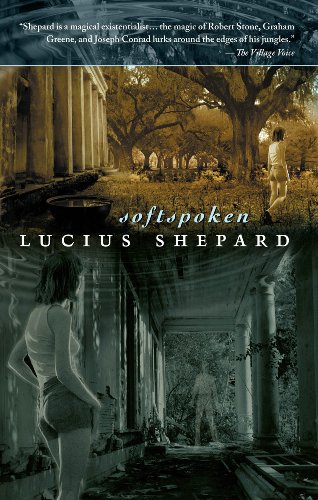
Words In: Softspoken by Lucius Shepard

Sanie Bullard has accompanied her husband Jackson back to his rural home town in South Carolina, where Jackson wants to be left alone to study for the bar. Sanie is on her own more than she’d like, and this forces her to confront just how lacking her marriage is. Jackson’s ancestral home, occupied by his crazy brother and sister, seems to be haunted by some kind of quiet, whispering spirit. Sanie keeps herself occupied by hanging around down at the country store half a mile down the road, and finds herself drawn by the flirtations of a local mechanic. The story feels like it’s less about the haunting and its affect on the Bullard clan over the generations, and more about Sanie feeling stuck in a bad marriage, trying to work up the courage or energy to do something about it.

Shepard writes beautiful, lush and detailed descriptions of the world of the story. He also does a great job getting into the head of the main character as well as drawing convincing portraits of the characters around her. The Southern Gothic quality is well done. I rate this book an extra star just for these things, matters of the writer’s craft.

On the other hand, I found the story too static, lacking even the amount of progression you’d normally find in a short story.

If you’re more interested in expressive writing than plot, and don’t mind a story that ends not too far from where it began, you may really love this. My own judgment is that I found a lot to like about the writing itself but found the story somewhat slight. I’ll gladly investigate Shepard’s other work, but the only recommendation I can give this book is conditional. Some readers will enjoy the stillness, others will be irritated at the “stuck” characters and situations.

Blood and Other Cravings, Edited by Ellen Datlow

There are all kinds of reasons I might read a short fiction anthology. Maybe it’s the only place to find new work by some of my favorite writers. Some anthologies serve to introduce readers to unfamiliar writers, either total unknowns, or familiar names I’ve somehow not yet gotten around to reading. Many readers are motivated by an anthology’s theme — “Oh, I love zombies, and here’s another zombie anthology so of course I’ll buy it” — but I usually don’t. I didn’t buy this because it had to do with vampirism. In fact, I imagine any reader who purchased this hoping for a bunch of straightforward vampire stories would be disappointed. There’s not so much “blood” here as there are “other cravings.”

I’ve given some consideration to the overall shape of multi-author anthologies, a subject which interests me to the extent it’s similar to the way I’ve put together various-artists CD collections in the past. Generally it seems editors load the best stories end up at the beginning and the end, and this is no exception. Among the middle stories, the only one I found noteworthy was Melanie Tem’s very odd “Keeping Corky,” about an enigmatic female character, notable for her mental abnormalities including both strengths and deficiencies, misses the child she was forced to give up for adoption.

Of the early stories, Kaaron Warren’s lead-off “All You Can Do is Breathe” is wonderfully creepy and understated. Elizabeth Bear’s “Needles” is not so much a story as a well-drawn and entertaining “day in the (undead) life,” vividly written but maybe in need of fleshing-out. And Reggie Oliver’s amusing yet dark story of a theatrical hotel overrun by very small tenants convinced me to check out more of this writer’s work.

The best of this collection comes later. “First Breath” by a new-ish writer, Nicole J. LeBoeuf, is an interesting exploration of a sort of transference of life through breath. And I always love Kathe Koja and Carol Emshwiller, whose contributions here (Emshwiller’s is one of only two reprints) are good.

The final four stories alone justify the price of the anthology.

Michael Cisco’s “Bread and Water” tells of a captive vampire trying to cope with his appetites, as well as an incapacity to consume what he desires. The creature’s gradual transformation, told in Cisco’s uniquely intense prose, evokes in the reader an effect like delirium. More than anything else in the book, “Bread and Water” inspired me to seek out more by this writer. That’s not to say it was the best story overall, but the best by an author I’ve previously overlooked.

Margo Lanagan’s “The Mulberry Boys” is told like a fable or second-world fantasy more than a horror story, but what’s actually happening here has quite a nasty edge. Through some bizarre process of surgery and altered diet, humans or human-like creatures are transformed into passive silk factories. I love the way this story is told. Very effective.

“The Third Always Beside You” by John Langan reminds me a little of Peter Straub’s recent novel A Dark Matter in its exploration of a male character trying to piece together disturbing past events. Here a brother and sister discuss their long-held perception that their father might have been unfaithful to their mother, and whether any truth might lie behind this. The fantastic elements along the way are of the subtle “thought I heard a sound, and looked, but nobody was there” variety, yet the story conveys a mysterious and even dreadful sense of secrecy. I own two of Langan’s books which I haven’t read yet, but this story convinced me to nudge these upward in my “must read soon” list.

The last contribution is by Laird Barron, recently the most consistently excellent writer of horror and dark fantasy novellas and novelettes. “The Siphon” includes elements which may seem familiar to readers of Barron’s earlier stories, but this comes across not as repetition, but a fleshing-out of a fictional world which increasingly cross-connects between one story and another. None of the characters, so far as I can determine, appear in prior Barron tales, yet the template of bored, wealthy decadents tantalized by forbidden or occult knowledge is reminiscent of such stories as “Strappado” and “The Forest.” Such is Barron’s skill that even when he’s not trying something entirely new for him (as I believe he did in “The Men From Porlock” and “Blackwood’s Baby” which appear in other recent anthologies), the work nonetheless functions at such a high level as to stand clearly apart.

By the end of a relatively mixed collection, it’s tempting to think mostly of the more satisfying later stories, but the quality dropped off enough in places that I’d give the collection four rather than five stars. At the same time, I’d recommend the book as worthy of purchase for the better stories at the beginning and especially the end.