Words In: Urn and Willow by Scott Thomas

Urn and Willow by Scott Thomas (Dark Regions Press) is a collection of short supernatural tales. The quiet, reserved style stands in dramatic contrast to the high intensity characteristic of much recent horror fiction. Urn and Willow has the feel and the scent of the worn and tattered volumes the reader discovers on a grandparent’s dusty bookshelf in childhood, strongly historical in orientation, and old-fashioned in both tone and setting. Pick up this book and read a few stories without first checking the publication date, and you might reasonably guess it had been published 75 years ago. The nostalgic quality of this collection arises not only from the date settings, but from the style of language and the very sensibility of the depicted worlds. By the end, there’s no doubt: Scott Thomas is obsessed with a given era and locale.

urnwillow

These simple little stories are almost delicate in their restraint and subtlety. This antique or old-fashioned quality is not mere backdrop. Supernatural things happen — ghosts appear, the dead walk, unexplained events manifest — yet much of the book’s purpose seems to be the careful rendering of rural New England, mostly in the early 19th century. Much as the stories focus on hauntings and supernatural mysteries, they’re equally about the loving depiction of an earlier place and time. Close attention is given to details of nature, home and land. We observe interactions and customs in tiny villages and get a sense of a simple, almost puritan approach to daily living.

A few of the longer stories stood out as more modern in approach, despite settings similar to the rest. In “The Bronze-Colored Horse,” one neighbor after another is victimized overnight by a terrible affliction. Investigation leads to the discovery of creatures from a surreal and terrifying dream. “The Seed of Increase Severance” likewise utilizes disturbing nightmarish imagery to tell a story that crosses multiple generations. “Miss Smallwood’s Student” tells of a tutor’s attempt to teach a very unusual young girl. In “The Company of Others,” an occultist hires an artist to paint a landscape mural in his home, and by occult ritual summons odd creatures who then share his home. These more ambitious stories, modern in approach if not setting, hint at Thomas’s ability to satisfy in a more adventurous, less conservative mode when so inclined.

The rest of the stories are unified by simplicity, brevity (most only 4-8 pages) and a throwback approach to depicting the supernatural. In these cases, the mere revelation of a disturbing event is enough. There is no twist, no gut-punch. To some readers, this is comfort food, difficult to come by these days. Scott Thomas is one of the few present-day writers serving up this sort of fare, and he does it with a deft, assured touch. This is a supernatural horror of chill and disquiet, not violence or extremity. Readers seeking the cutting-edge may find Thomas’s work too subdued, but those who enjoy the restrained approach of yesteryear will find much to appreciate. The book is redolent of a slower, simpler world. With Thomas’s polished and confident style, Urn and Willow vividly evokes another time and place.

Words In: A Season in Carcosa, Edited by Joseph S. Pulver Sr.

This is one of the most significant multi-author anthologies of recent years. A wonderful, concentrated batch of intoxicating goodness, sure to please readers of weird fiction and horror.

Season in Carcosa

Every anthology includes pieces that don’t work for all readers. All too often, the reader must be satisfied with just a few strong stories in the mix. In this case, the intelligent and provocative bullseyes greatly outnumber the few misses. Some of the highlights come from reliable writers such as Laird Barron and John Langan, who lately seem never to miss the mark. Both use the “King in Yellow” theme as an excuse to try something a little different, to veer off the path of their usual focuses and themes. Barron does something that feels much like veiled biography, in which a Carcosan entity visits an author who seems clearly inspired by Karl Edward Wagner. Langan’s tale has the feel of nightmare, and follows an actress as she stumbles through an extraordinary soundstage during the filming of a project seemingly attuned to a world other than our own.

The greatest anthologies are important because they do more than just parade one famous author after another; they bring to the reader’s attention work by less familiar names. I’d never read anything by Gary McMahon before, but his Bukowski-inflected noir, “it sees me when I’m not looking,” was a wonderful surprise. Edward Morris comes up with a surreal and disturbing tour de force, “The Theater and its Double.” This complex and ambitious piece blends poetry, screenplay, and stream of consciousness.

Favorites here include Allyson Byrd’s “The Beat Hotel,” an atmospheric, art-flavored 60s-in-Paris wonder that hit this reader’s sweet spot, and Cody Goodfellow’s extravaganza of mental illness, drugs, dark ritual and mind control, all with a children’s television backdrop, “Golden Class.” Other standouts included stories by Daniel Mills, Pulver, Strantzas, Richard Lupoff and Joel Lane. As often happens in tribute anthologies, the most successful stories went beyond mere emulation and instead used an author or story’s themes to do something in the writer’s own style.

Themed short fiction anthologies roll out into the marketplace too quickly for any reader to keep up. In any given year, there are a few standouts worth every genre reader’s time. A Season in Carcosa is one of those special few deserving of wider attention.

Words In: Hitchers by Will McIntosh

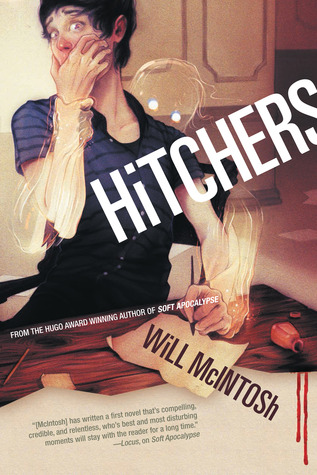
On a single day at the beginning of Will McIntosh’s Hitchers (Night Shade Books), cartoonist Finn Darby loses both his wife Lorena and his elderly grandfather, who 40 years earlier created the successful comic strip Toy Shop. The grandfather previously made clear his refusal to allow Finn to take over the strip after his own death, but as it turns out, Finn easily convinces his grandmother that continuing the strip will benefit them both. Finn keeps “Top Shop” running, introduces new characters, and signs licensing deals, and these changes bring popularity, fame and wealth.

Hitchers_Press_rv01.indd

When a major terrorist attack strikes Finn’s home city of Atlanta, the half-million sudden deaths bring about the novel’s premise: Spirits of the recent dead take over the bodies of the living. These “hitchers” appear first through verbalization, then gradually control the bodies of their living hosts. The novel’s emotional impact is strongly front-loaded. Events pile up fast in the first few chapters. Along with a few characters entangled with him, Finn seeks to understand what’s happening, then manage the interference of these “hitchers” as the influence they exert over the living increases. Finn partners with Mick Mercury, washed-up 80s rock star, and waitress Summer Locker, who Finn and his wife encountered just before Lorena died.

McIntosh presses the story relentlessly forward, in a straightforward, unadorned style, with brief scenes and chapters. Characters move briskly from place to place, event to event. The overall tone remains breezy, despite a brief serious turn in the early going as characters adjust to the loss of loved ones, and greater Atlanta copes with mass death. These scenes are affecting, and come across as “real” in a human way. McIntosh conveys Finn’s conflict between a selfish desire to control “Toy Shop” and an impulse to respect his grandfather’s wishes.

As events progress, the story unfolds at double-speed so that the last half of the book seems compressed. The reader glides along the surface at an increasingly superficial level. Significant story milestones fly past, and the plot jumps forward, more synopsis than narrative. A long-developed romantic triangle is resolved in just a sentence or two. A character’s mindset suddenly jumps from problem-solving to giving up all hope, without much in the way of transition. These plot turns feel less true, less emotionally justified than what came before.

Just when the plot seems to be on a rail headed toward inevitability, McIntosh pulls out some rewarding surprises and nicely resolves the ending. Hitchers offers an interesting setup and likable characters whose conflicts and drives compel the reader. Despite pacing issues in the second half, it’s an enjoyable and entertaining read.

Words In: Twenty-Eight Teeth of Rage by Ennis Drake

This short debut novel quickly establishes that newcomer Ennis Drake can really write. The narrative voice is strong, rich with nuance and flavor. Scene after scene exhibits Drake’s competence at playing out a narrative thread. The book is clearly in the horror category but also has a noir genre feel to it, including the common noir element of the emotionally or psychologically damaged law enforcement officer for a main character.

The whole story, every character interaction, is a pool of hard, bitter emotions. Everybody in the book seems hurt and wanting, stuck in an agonizing pattern of self-defeat and dysfunction. Characters seem realistically flawed, emotionally alive. It’s clear what they want and what’s keeping them from getting it. Drake’s strength as a writer is in clearly rendering these people (particularly Riley, the protagonist) so they seem believable and familiar to the reader. Throughout this book, I felt what the characters felt. The ability to give the reader this experience is arguably the most important determinant of whether a book succeeds or fails. On this test, I say Drake easily passes. The novel is quite strong in terms of execution, of conveying believable characters with a strong narrative voice.

An aspect I consider less successful is the central conceit of the possessed or demonic power saw. Much of Stephen King’s very popular oeuvre has been built on similar concepts — such possessed/demonic objects as a hotel, laundry press, lawnmower, classic car, eighteen-wheeler, even a St. Bernard. Despite King’s success with this approach, I’d argue a stronger, more interesting antagonist or threat could be created by not merely applying demonic or malignant qualities to a mundane object. I’d love to see Drake’s skill for storytelling, and the creation of realistic characters, applied to a stronger, more complex basic concept.

The only other shortcoming is in those sections of written or recorded testimonies of characters in their own voices, which sound not like a real person telling their story, but more formal, like a novel’s narrator. Through these segments important backstory is revealed, so these passages are necessary, yet the tone is slightly off. This problem does not exist with the novel’s spoken dialog, which is both naturalistic and believable, so it’s clear Drake knows how to convey the way people really speak. This minor quibble applied only to the sections of Jodi’s diary and Strom’s recorded testimony, and really didn’t detract much from my enjoyment of the book.

These reservations were certainly outweighed by the confident, fluent prose and believable characterization. Overall, Twenty-Eight Teeth of Rage is a compelling, passionately-told drama, and a successful piece of writing. From the first page I was impressed with Drake’s ability to draw the reader into an intense, vividly emotional scene. Flaws may be present, but not many for a first novel. I’m eager to see how Ennis Drake applies his obvious authorial talents to different story concepts in the future.

Places Where My Book Reviews Go

I always read a lot. Lately I’ve been writing reviews of almost everything I read, and posting those reviews in several different places. Here’s where they go, in case you’re a reader interested in seeking out other places to read book reviews, a writer whose work I’ve reviewed who wants to see all the places those reviews appear, or an amateur book reviewer looking for places to put your own reviews.

GOODREADS – (Goodreads profile)
In most cases I post the review first to Goodreads. Serious readers and book lovers who don’t know about Goodreads should check it out. It’s a place to see what other people are reading, and many members post reviews, which in some cases are useful. There are lists, suggestions, book groups, all kinds of stuff. Some of it’s good, some of it’s self-promotional and lame (lots of self-published people spamming groups with announcements and sales efforts) but I really like Goodreads.

AMAZON – (My reviews on Amazon)
I crosspost the same reviews to the book’s Amazon product listing, assuming it has one. If you see a review of mine that you like, remember to mark my review “helpful,” which increases Amazon’s ranking of my reviews’ influence. This way my review will be shown more prominently, with other reviews considered helpful. One way you can help influence how the books you like (or don’t like) are perceived is by rating Amazon reviews “helpful” or “not helpful,” which will make them more or less likely to be viewed by other shoppers. I prefer my reviews to be seen by as many people as possible so I like those “helpful” ratings.

BLOG – Livejournal – (griffinwords.livejournal.com)
This began as my main blog, the one I usually told people about, but I’ve gradually evolved to having the same blog entries cross-posted to three blog platforms. More and more, I’m pointing people to my WordPress just because it looks better. That, and Livejournal seems to be a dying community.

BLOG – WordPress – (griffinwords.wordpress.com)
As mentioned above, this has the same entries as my Livejournal, but WordPress looks better and has nicer tools for announcing posts to Facebook and Twitter in a nice, automated way. Increasingly I direct people toward the WordPress blog, and I may eventually narrow it down to just this one blog.

BLOG – Dreamwidth – )griffinwords.dreamwidth.org)
Dreamwidth began as an offshoot of Livejournal, and there was some indication that DW might carry forward some of LJ’s community or “social network lite” benefits. In the old days, the real benefit to LJ was the “friends list” and the centralized way it let you review all your friends’ recent blog entries on one page. Not many people ended up switching over to Dreamwidth, though I suppose it could still happen.

FACEBOOK – (Facebook profile) and TWITTER – (Twitter profile)
I don’t post the reviews themselves here (at least not in full), but links to some of the above do appear. I have fun with these things, make smart-ass little remarks, post pictures, but neither one of them is really built for posting serious or even half-serious writing. Obviously the benefit here is reaching a larger number of people quickly, so I use these for announcements and links to heartier content at the various places above.

I welcome “friends” and “followers,” especially people who share similar interests.

Words In: Radiant Days by Elizabeth Hand

Radiant Days begins in 1978 following Merle Tappitt, fled from an abusive redneck childhood for the only slightly greater comfort of art school. She explores her own artistic impulses and means, and makes a few friends among fellow students, as well as one female teacher who takes a special personal interest. Stimulated by the nascent scenes of punk rock music and graffiti art, Merle herself takes up graffiti, inspired by the work of “SAMO” (a real-world tag which belonged to Jean-Michel Basquiat before he became an art world superstar). Her signature tag gives the book its title.

Before we get too far into the story of Merle, the story switches to 1870 and the point of view of a teenage Arthur Rimbaud, likewise going through parent-related difficulties and struggling to find his muse. Although Merle Tappitt and Arthur Rimbaud are separated by an ocean and more than a century, they inexplicably meet, after each has an encounter with a mysterious old fisherman. Rimbaud speaks French and Merle English, yet they understand each other without trouble, cross briefly into each other’s worlds and apart again.

Radiant Days

I love the depiction of the lives of young, rough-edged creative people. As in her Cass Neary novels (Generation Loss and Available Dark), Hand portrays the gritty, often unglamorous daily life and struggles of the creative person in a way that seems true, equal parts grim and inspiring.

Something Elizabeth Hand does better than anyone is show the way impressionable creative types juggle influence and inspiration. A painter might be influenced by music or poetry, might try their hand at charcoal portraits, join a band, or spend a year doing graffiti art. That’s the way real artists find their way, develop a personal style or voice, yet it’s rare to see this path to artistic selfhood portrayed in fictionalized lives of artists. The struggle toward creative self-expression is messy, non-linear, full of self-defeating detours and periods of fallowness and frustration. Radiant Days captures the young artist’s struggle for clarity, for insight and direction.

Though Radiant Days is marketed toward the “Young Adult” category of reader (and I’m much older than that), I enjoyed it for Hand’s clear, expressive writing and the honest way she depicted the struggle of the artist, using both the fictional Merle Tappitt and the drawn-from-life Arthur Rimbaud.

Words In: Tender Morsels by Margo Lanagan

I wanted to like this… awards, a beautiful cover. A dark fairy tale, people said. Negative reviews mostly objected to rape, incest and bestiality in a Young Adult book. I’m not easily offended. Things began well. Lovely prose.

The problem was dullness, monotony. Scenes repeated, seemingly without aim. Man-bear nuzzles up to vulnerable human female… how many times? I got it the first time. Even for readers accepting of harsh content, the middle 150 pages are tedious. Lanagan’s short fiction is intelligent, beautifully written, but despite lovely prose I can’t recommend Tender Morsels except to (very patient) fairy tale lovers.

Words In: Immobility by Brian Evenson

Brian Evenson, one of my favorite short story writers, specializes in brief, enigmatic mysteries with a Kafkaesque flavor. Most of his collections have come out from publishers with more of a literary/experimental focus (Underland, Coffeehouse, Four Walls Eight Windows). It wouldn’t seem unreasonable to categorize Evenson as a straight “literary” writer whose work contains speculative or “genre” elements only to accentuate the weird unease in a Kafka/Lynch sense, and not as raw meat for a genre readership. Such a conclusion about Evenson’s work might seem to be argued-against by the release of Immobility, a post-apocalyptic tale which almost be called an “adventure” (if a quiet one), published by SF/Fantasy powerhouse Tor Books.

The story begins with the awakening from cryogenic stasis of Josef Horkai, a paralyzed amnesiac with unexplained resistance to the environmental toxins and radiation which keep the rest of the few surviving humans hiding underground. He’s given a mission by Rasmus, seemingly in charge in this desolate, wrecked post-Kollaps aftermath, and a pair of “mules” named Qanik and Qatik, twins or perhaps clones, carry Horkai on the assignment. On the way, Horkai tries to get information from the mules, whose responses often seem nonsensical, yet sometimes contain information or even wisdom.

Horkai’s muddled memory, which leaves him uncertain about such basic facts as whether he’s even human, drives him even more strongly than any assigned mission. Immobility isn’t just about Horkai’s paralysis, but about his inability to choose any direction for himself because he lacks the necessary information to judge his own situation. Plagued by cyclical memories of sleeping and awakening from sleep, Horkai struggles to understand who he is, and how to deal with direction in which he has no say. I take this as a direct and explicit comment about the way some religions keep followers in the dark, use them as fodder for the promulgation of the faith. Evenson’s own history as a former member of the Mormon church, and the story taking place in Utah, particularly near the Brigham Young University campus, would seem to support this interpretation.

The story is reminiscent of Cormac Mccarthy’s The Road in terms of mood, yet in that story the protagonist was strongly driven toward a certain end. Horkai isn’t sure what he’s seeking, beyond the most basic sort of self-knowledge. The foundational nihilism of Immobility should come as no surprise, as in his acknowledgements Evenson name-checks Thomas Ligotti, a horror writer noted for his pessimism about humanity. I enjoyed Immobility, found it stimulating and well-written, though not quite as sharply-honed as Evenson’s short works. It’s worthwhile for those readers who enjoy darker tones and a bit of philosophical challenge, but may be too bleak for some.

Call Me the Hundred Word Critic

Lately I’ve been stressing out too much about writing reviews of the books I read. I really enjoy thinking about books critically, playing reviewer in even a semi-formal way. As a way of reducing the pressure of reviewing a bit, while still allowing me to write something about everything I read, I’ve decided to try keeping all my reviews to exactly 100 words. It’s a bit of a wordplay game, condensing and concentrating what I wanted to say into that small number of words. Also seems like something easy to write within a small period of time.

So for now, I’ll think of myself as the hundred word critic.

Words In: The Light is the Darkness by Laird Barron

Conrad Navarro, modern gladiator in a secret underground battle series called The Pageant, pursues his lost (possibly dead) sister Imogene.

Told in a style quite different from Barron’s recent novel The Croning. Pulpy, fast-moving. Seemingly less serious, yet at its core abysmally dark. Some sections more briskly written, while others contain Barron’s characteristically dense, flavorful descriptions.

As with The Croning, strange events are gradually revealed to take place on a grandiose, primordial scale. Part epic, part comic book, part myth. Gods and demigods stride the Earth, concealed among us, concerning themselves with matters frightful and destructive to ordinary mortals.

The Light is the Darkness