H.P. Lovecraft Film Festival – Con Report, Part I – Before

I’m breaking my convention report into several blog entries. The first is “Part I – Before,” the name of which should make clear that it covers everything up to the actual beginning of the Film Festival on Friday afternoon.

Though the H.P. Lovecraft Film Festival and CthulhuCon didn’t officially start until Friday, “con weekend” started Tuesday for me and my wife Lena. Tuesday evening we went to PDX (that’s the airport — I’m philosophically opposed to calling Portland by that abbreviation) to pick up author, convention guest and noted weirdo Joe Pulver. Joe writes under his full name Joseph S. Pulver Sr. and you can read about him here.

pulver

Joe had been a good online and long-distance friend for a bit less than two years, but this was our first time meeting Joe face to face. In this internet age, many of us have experienced the shock or disorientation of meeting an online friend and finding little similarity between the expectation and the flesh-and-blood person. Probably because of so many Skype video chats, Joe looked, moved and spoke exactly like we expected he would. No weird surprises at all, just familiarity. My theory is that when it comes to meeting online friends, this potential shock can be diminished by speaking to them on the phone, at least. Even more helpful in matching one’s preconceptions to a semblance of the actual individual is the video chat, such as Facetime or Skype.

Joe had warned us that the 26 hour flight from Berlin to London to Dallas/Fort Worth to Portland would probably leave him sore and tired, but he arrived buzzing with energy and enthusiasm. While we waited in baggage claim, I emailed an important friend of Joe’s back in Berlin to let her know he’d arrived.

My clever wife had left a beef stew dinner simmering at home, so when the ravenous bEast (Joe’s nickname) arrived, there was food to be had. After dinner, Lena and I thought, “Surely now he’ll crash and sleep for 16 hours,” but he was still buzzing almost until midnight. Neither she nor I had traveled 26 hours that day, but we finally had to surrender and say, “OK, time to sleep.”

Wednesday I had to work the first half of the day, and after that I picked up our second guest, Mike Davis, editor of Lovecraft eZine. Also a guest at the convention, Mike had been offered a hotel room by the con organizers, but wanted to come a day earlier than the room was available. We offered to pick Mike up, let him stay with us Wednesday night, then take him down to the Hollywood district to get his room at the Banfield.

lovecraftezine

Back home, we dropped off Mike’s luggage and picked up Joe and Lena for a Mexican food lunch — not Portland’s best, but a place nearby with a huge menu offering something for everyone.

As with Joe the night before, Mike seemed instantly familiar to the rest of us. Further proof of my theory that if you don’t want your internet buddies to seem unfamiliar as aliens when you finally meet up, you ought to Skype or Facetime first!

After lunch, Joe wanted to take a trip to WalMart to pick up a few mundane essentials not readily available in Berlin. We ended up browsing slowly, ranging all over the entire store. Lena and Mike chatted, getting to know each other a little better. I tried to get Joe to buy a tiny outfit of Iron Man “top and bottom” underwear, but he wouldn’t do it. Possibly they would have been too small, anyway.

ironman

We also picked up a few items needed for dinner. As an American resident of Berlin for the past few years, Joe had a list of favorite foods he wanted to experience while stateside. Tonight it was grilled bratwurst (it only occurred to me later than Joe probably had no problem finding German sausage in Germany), plus corn on the cob and cole slaw.

After, we watched Berberian Sound Studio (see my earlier review here), at least until Joe started falling asleep sitting up on the couch. That night, nobody had to be convinced we could use some sleep.

Thursday morning I made a giant frittata and 2 pounds of thick-cut bacon. The enormous vat of eggs and cheese and shredded potatoes took an eternity to bake, but the end result, combined with the mountain of bacon, kicked off a nice week-long stretch of overeating. Grub!

Our plan for the early part of the day was to take a scenic drive out the Columbia River Historic Highway. Mike wasn’t feeling well, and decided to stay at the house and rest up. We made it as far as the Women’s Forum Overlook before we found the highway was closed for construction.

lenajoe

We sidetracked to the main highway, and reconnected with the scenic route past the construction, near Latourell Falls. This drive, when it’s open, is one of my favorite outings on which to take visitors.

gorgeview

The drive gives a great overview of the gorge from several perspectives, and passes by a half-dozen very different waterfalls, including the king of them all, Multnomah Falls.

multnomahfalls

After the detour, we had to cut the drive a bit short so we’d have time to make scratch chili (the next item on Joe’s “must eat American foods while I’m here” list) and finish dinner before the evening’s pre-party.

jalapenos

On our way to the party, we tried to check Mike into his hotel. The festival organizers planned to provide him with a room for Thursday through Sunday nights, and he was only planning to stay with us Wednesday night until his room was ready. There was a problem with the reservation, so we decided Mike would stay with us Thursday night as well, and take another crack at the hotel on Friday.

While at the Banfield Hotel, we met Wilum Pugmire, who needed a ride, so he hitched along. What group of Lovecraftians wouldn’t want to add the fabulous Wilum to the fold?

wilumpugmire

The pre-party was an optional, open-admission event which took place before many HPLFF guests had arrived in town. Outside the Lovecraft Bar, waiting to get in, we met a few other attendees, like Cameron Pierce, Rose O’Keefe and Jeff Burk, for whose book Shatnerquest the pre-party doubled as a book release party.

lovecraftbar

Inside, Lena and I sat with Wilum, and Joe drifted around the room with Alicia Graves, another Facebook friend who had just arrived.

aliciajoe

After an introduction mentioning Jeff Burk and his new book Shatnerquest, Ross Lockhart read a section from his excellent debut, Chick Bassist. There was too much echo on the public address for a reading, but the general idea off Ross’s book came across.

rosslockhart

There was a wild and bizarro-appropriate musical performance by Effword, followed by a crazy circus sideshow performance by a sister trio. Nails hammered into faces, holes power-drilled into sinuses, and so on.

sideshowsisters1

Eventually they built a many-layered construct of beds of nails and scantily dressed sisters, on top of which stood the third sister spinning a hula hoop.


(video by Mike Davis, Lovecraft eZine)

nailsandhoops

Throughout the evening, Jeff Burk offered a series of raffle giveaways. I won a raffle prize — both of Jeff’s Shatner books, Shatner Quake and Shatnerquest — and Joe Pulver won another prize, a Lovecraft Bar t-shirt. Our group dominated the raffle winnings!

lovecraftbarsign

Apart from this once-yearly event related to the HPL fest, the Lovecraft Bar is worthy of mention in its own right. It’s on the small side (and was totally packed for this event) with a suitably goth/horror decor, and walls so packed with photos and art, I wish I’d had time to look more closely. Portland is fortunate to have such a cool Lovecraft-themed bar, to go along with the film festival a few miles away. I was surprised how many Lovecraftians present, many of whom were Portland residents, or many-time attendees of the HPLFF con, had never been to Lovecraft Bar before.
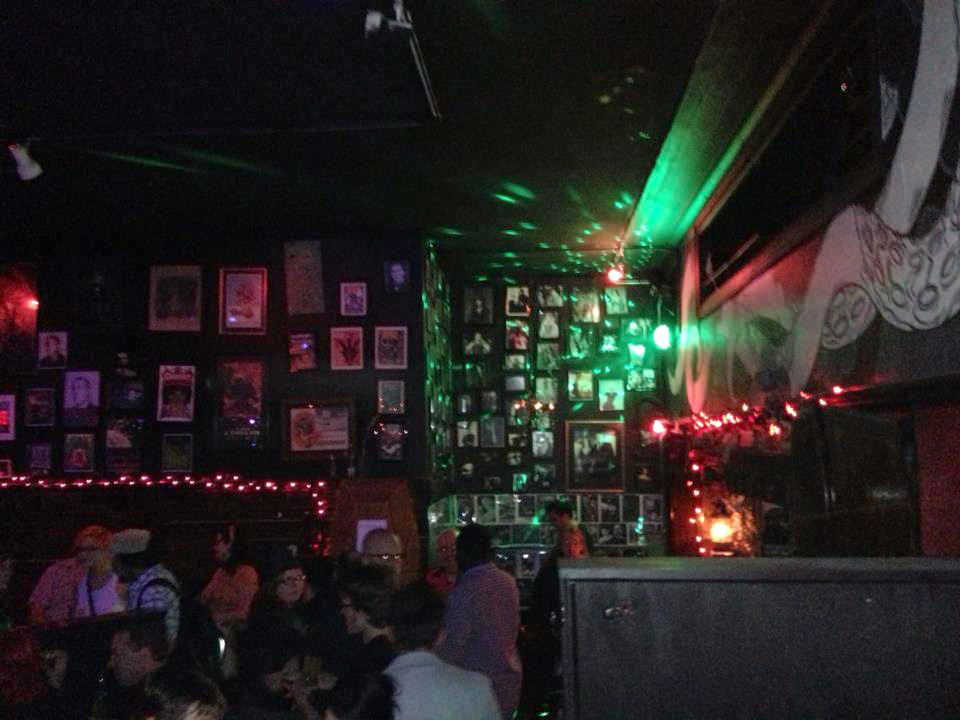
lovecraftbarinterior

This relatively late Thursday night marked the end of our pre-festival activities. The next day, Friday, the real action would begin!

HPLFF Con Report Coming Up

I’ve been preparing my blog report on the recent H.P. Lovecraft Film Festival, and have had to break it into several parts. So much happened. It’s hard to keep everything straight, to remember the sequence of events, which people I met on which days.

HPLFFkickstarter

Here’s the statement I made on the event’s Facebook page:

Two primary impressions remain in the aftermath of the H.P. Lovecraft Film Festival:

1. Wow, I got to have fun with SO MANY cool and amazing people!

2. There were SO MANY other interesting and cool folks I barely spoke with, or didn’t even get to meet!

All weekend, such a great whirlwind of stuff going on. Such abundance of opportunities for friendship and learning and amusement and exchange of ideas. Seriously, if you’re at all interested in this kind of stuff and don’t attend next year, you’re missing out on something great.

While I get my memories and words organized, here are a few other HPLFF con reports by people I met along the way.

Wilum H. Pugmire – More HPLFF Memories

Molly Tanzer – fun times at the h.p. lovecraft film festival

Orrin Grey – Tripping

You can also scroll through the event’s Facebook page for all kinds of pictures, observations and reminiscences about the con.

My own report will begin soon…

H.P. Lovecraft Film Festival 2013

I’ve been way too busy during this year’s H.P. Lovecraft Film Festival and CthulhuCon to blog, but I’ve posted lots of pictures and comments on Facebook so you can follow me there.

Mike Griffin on Facebook.

My wife Lena and I have had Joe Pulver aka notorious author and provocateur Joseph S. Pulver Sr., as well as Mike Davis of Lovecraft eZine staying at our house since the middle of last week. Not only has it been fun having them around, but taking part in the festival as part of the “posse” of two guys as well-known and beloved in the Lovecraft scene as Mike and Joe has been especially entertaining.

I’ll recap events and gather photos here soon.

This afternoon, I’ll be reading in the EOD Center a block or two from the main theater. I’m reading something very short, about 10 minutes long. It’s in the “Reading 5” block from 4PM to 5PM, an hour block shared with two other writers. INFO HERE. Hope to see a few of you there!

Catching Up With Incoming Words

No, I have not written three entire book reviews in under 24 hours.

I’ve been way behind on posting reviews of some of the books I’ve read, including some I finished reading months ago. This backlog was stressing me out! Some of the reviews were mostly written and just needed to be assembled. In other cases, handwritten notes just needed to be typed up.

It feels good to clear the decks a bit.

I will probably cut down on the number of reviews I’ll write for a while… after I get through a few things like At Fear’s Altar and Jagannath and Staring Into the Abyss and Hair Side, Flesh Side.

I do love to talk about books and writers, and possibly help in some small way to boost those that deserve it. I also think it’s helpful, in a selfish way, for writers to think carefully and critically about other people’s writing. What works, what doesn’t, and why. It’s always seemed to me that writers derive more benefit from giving critiques than receiving them.

Despite my enjoyment of this book review thang, I need to scale back, at least for a while, the self-imposed sense of obligation. I’ll still talk about the books I’ve read, probably more briefly and off-the-cuff.

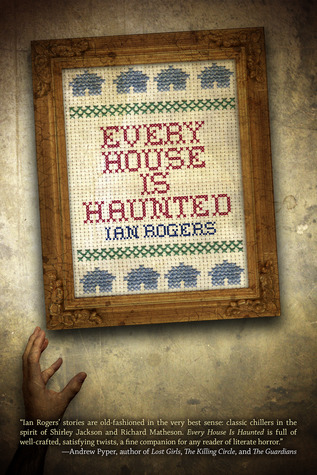
Words In: Every House is Haunted by Ian Rogers

Many of the 22 short stories in Every House is Haunted, the debut collection by Ian Rogers, feel connected. As the title suggests, this is a book about hauntings, though the stories Rogers tells venture beyond the well-worn template of the haunted house tale. On top of this unifying theme, several stories also feature paranormal investigators, something like agents Mulder and Scully of the X-Files, or hint at a shadowy group overseeing such intrusions. Rogers seeks to establish a common world in which paranormal events and entities are controlled, studied and policed by a broad and shadowy organization devoted to these functions.

Every House is Haunted

Rogers starts off strong with “Aces,” on its surface a routine family drama in which Toby’s sister has trouble in school and exhibits weird behavior, like many adolescents. This seeming normalcy masks the extreme strangeness of what’s really going on with the sister, who is obsessed with finding “aces,” playing cards which she discovers in strange places, such has hovering in mid-air. Toby only comes to understand his sister’s unusual nature when paranormal investigators arrive and explain.

Another strange and surreal piece early in the book, “A Night at the Library With the Gods” again displays Rogers’ skill for creating a familiar, mostly normal world, then gradually increasing the strangeness until the reader recognizes they’re in something more akin to nightmare. In “The Dark and the Young,” linguist Wendy takes a mysterious job, translating an occult “black book.” Some of the rituals described in this bizarre text make Wendy and some of her coworkers hesitant to participate.

A few less mature stories are sprinkled throughout, and in my opinion Rogers could have made a stronger debut impression by omitting these. I understand the desire to include early work, and indeed this flaw is so common in first collections I’m hesitant to mention it. At any rate, the few less-compelling pieces are more than offset by a high overall quality. The more recent stories seem generally darker, more macabre or surreal.Rogers closes the collection with a powerful series of tales, deftly and confidently told.

In “The Inheritor,” Daniel Ramis unexpectedly inherits a house from his father, with whom he had a terrible relationship. He visits the childhood home, a place evoking the terrible memory of his sister’s early death. Daniel always thought his father had sold the house when he moved, and can’t understand why he’d held onto it. Along with the house, Daniel is also left contents of safe deposit box: a gun, and a note from his father hinting at explanation. All that remains is for Daniel to discover what responsibility comprises the most horrible aspect of his father’s legacy.

A husband in “The Candle” gives his wife a guilt trip about possibly forgetting to blow out a candle before coming to bed. Time passes, and feeling guilty, he goes downstairs and finds something weird and disquieting in the dark. Here’s another story that starts off realistic, then takes a weird disconnect, making a subtle and eerie observation of the ways we open gaps in relationships through small acts of selfishness or distrust.

The last tale, “The Secret Door” makes a powerful ending to the book. Sarah and husband move into an old country house, and find a secret door bricked up on back side. She sleeps, and wakes again to find her husband’s not there. Other details, such as the bed and their car, inexplicably have changed. The story veers more deeply into surrealism. Sarah envisions a boy yelling from the bottom of a well, telling her she’s the one who put him there, hinting at connection to her earlier decision never to have kids. Her experience swerves between alternating realities, now alone and sick, then with her husband telling her she’s not well. It depicts increasing detachment from reality, a creepy back-and-forth between the real and the surreal.

Every House is Haunted is an above-average short fiction collection, especially noteworthy as a debut. The writing is both transparent enough for mainstream readers, and artful enough for those who like their prose with an edge. At his best, Rogers is very compelling, and the growth demonstrated within these pages suggest he’s one to watch.

Words In: Die, You Donut Bastards by Cameron Pierce

Die, You Donut Bastards is the latest collection of short fiction and prose poetry by Cameron Pierce. The whimsical title and cover art may suggest a mostly humorous approach to Bizarro, a genre which can range from arty surrealism to shock-focused extremity, and also at times encompassing more conventional storytelling with a subtler twinge of the surreal. While many authors focus on a single approach, Pierce here shows himself capable of covering all the bases.

Die You Doughnut Bastards

Most of the pieces are just a page or two, and focus on wild invention and playful absurdity. I detect in these shorter works the influence of Russell Edson, the master of surrealist prose poetry, though Pierce is less oblique, less blatantly symbolic, and more confrontational. Readers approaching this book from outside the Bizarro realm can expect a lot of zany humor and intentional absurdity, but will also discover a great degree of subtlety and sensitivity. In fact, those seeking a full-on Bizarro blast may be surprised by the restraint and emotional honesty present in the longer stories.

The lengthiest of these, “Lantern Jaws,” is a lovely tale of wonder and emotion, both subtle and graceful, reminiscent of something Kelly Link might create. In it, a teenage boy falls in love with a girl schoolmate who carries a vaguely Lovecraftian doom or curse. It’s a gentle, touching story, characteristics which may seem at odds with some of the extremes on display elsewhere in the book, yet it’s also quite dreamlike and surreal.

Another longer story, “Death Card” shows a couple, Tristan and Emily, shifting from youthful, carefree obsessions, such as Tristan’s comics and his collection of vinyl figures, to more adult concerns now that Emily is pregnant. Tristan goes along, half-reluctantly boxing up his collection to make a room for the baby. The story focuses the feelings of impending loss and disconnection from self, arising from Tristan’s recognition that life’s simple freedoms and youthful pleasures are soon to change.

In “Pablo Riviera, Depressed, Overweight, Age 31, Goes to the Mall,” an odd outsider catalogs an endless stream of pleasures, mostly fast food, during a trip to a shopping mall. This litany of cheeseburgers, taco corn dogs, and other excessive treats could be seen as Pablo’s attempt to numb the pain of his solitude and isolation, or perhaps simply exhibits the weirdly alienating effect of our obsession on grotesque, commercialized pleasures.

“Disappear” is the weird story of a pregnant woman’s baby disappearing right out of her belly. It turns out the fetus was stolen by horror author Stephen King, who apparently steals unborn babies and installs them into his typewriter as fuel or grist for new stories.

In “Mitchell Farnsworth,” one of the more transgressive pieces, Katie recollects once having sex with her boyfriend, the Mitchell Farnsworth of the title, while watching the movie Alien. After Mitchell moves on, the story recounts Katie’s long string of boyfriends, forming a detailed catalog of explicit sex acts, foods and drinks consumed, and the movies she watched with each — often Alien, sometimes The Exorcist or other horror films. Katie is increasingly stuck, unable to stop and reflect on this pattern, until she hears news about Mitchell Farnsworth.

In Die, You Donut Bastards, the shorter, weirder stories are greatest in number, and seem more geared toward a Bizarro audience. The longer stories, comprising about half the collection’s page count, exhibit greater emotional realism and even a bit more seriousness mixed in with the strange pop surrealism. I enjoyed the provocative range of styles, moods and approaches on display in Die, You Donut Bastards. It makes me eager to check out more Pierce’s work.

Words In: Chick Bassist by Ross Lockhart

Chick Bassist is Ross Lockhart’s debut as a writer of fiction, after establishing himself as a fantasy and horror editor best known for two successful Lovecraftian “Book of Cthulhu” anthologies. Despite Lockhart’s genre editing background, the only fantasy in Chick Bassist is of the rock-and-roll variety.

Chick Bassist

This book is crazy fun, often funny, but it also has a serious feel, as troubling and difficult as real life. It tracks the passions and conflicts of an enjoyably grungy cast of dysfunctional characters, every one of them f**ked up in a charmingly rock-and-roll sort of way. Lockhart realistically captures the fun and filth of the garage music scene, the transitory existences of bands, the passionate creativity and train-wreck lifestyles. The characters and their scene are clearly personally known to the author, and will seem familiar to anyone who has played in bands or at least been part of that milieu.

Told from multiple viewpoints, the story not only switching character perspectives, but also juggling first, second and third person points of view. The title refers to Erin Locke, “the Queen of Rock,” who leads the band Heroes for Goats until things implode, and she takes off to play bass for a more successful band. Other points of view follow Robbie Snow, the bassist kicked out of Heroes for Goats for acting all mental after Erin had sex with him, and Christian, who ends up getting a severe beating by Robbie after Erin makes Christian kick him out of the band.

At its best, rock and roll is about ambition and failure, about lessons learned too late, about love, and also death. Chick Bassist is crammed full of these things. If you think you might enjoy a punk/grunge flavored book about underground bands and musicians, you’ll love this Chick Bassist. I browsed the first pages of this book when I was already in the middle of reading something else, and this one immediately sucked me in.

As for the “Would you read a sequel?” test, Chick Bassist easily passes. I’d gladly read the further adventures of Lockhart’s rock and roll characters. Bring it on!

Words In: Fungi, ed. Orrin Gray & Silvia Garcia-Moreno

Fungi, edited by Orrin Gray and Silvia Garcia-Moreno, collects about two dozen weird and fantastic stories focused on the theme of fungus, including mushrooms, molds and a whole related class of bizarre life forms.

I expected mostly dark tales of decay and derangement, but many of the tales here turn out to be lighthearted, whimsical, even silly. Whatever one’s preference in terms of tone, Fungi undeniably contains a healthy measure of strong genre fiction. Whether due to my own predisposition toward more serious horror and dark fantasy, or because the more playful efforts are not as strong, I consider the most successful stories here to be those darkest or most surreal in tone. The work of John Langan, Laird Barron, and E. Catherine Tobler stood apart in my estimation.

Image

Langan’s lead-off “Hyphae” is a concentrated dose of nastiness. I dare anyone to read this without at least once letting out a disgusted, shuddering moan. I haven’t seen Langan write something so viscerally gruesome until this. So awful, yet wonderful. I loved it.

Laird Barron never disappoints, and his “Gamma,” a cynical yet emotionally powerful survey of childhood, adulthood, entropy and decay, balances a boy’s recollection of his father killing a lame horse named Gamma against a present-day, adult contemplation of his wife leaving him for another man. The story looks outward to embrace death and human existence more generally, and finally broadens to face horror on a truly cosmic scale.

It’s worth noting that E. Catherine Tobler’s “New Feet Within My Garden Go,” which may well be my favorite piece in the book, is a bonus story present in the hardcover but not the paperback version of Fungi. It’s a shame many readers will miss Tobler’s tale, which is complex, detail-rich, and overflowing with delicious, poetic weirdness. Beautifully and artfully told.

Another handful of stories deserve mention. Nick Mamatas describes in “The Shaft Through the Middle of It All” an apartment building where fungus growing in a ventilation shaft can bring harm to residents, though another use of fungus brings a kind of retributive power. J.T. Glover’s “The Flaming Exodus of the Greifswald Grimoire” tells of two brother sorcerers, adventuring grimoire hunters who find trouble when they try to snatch a tempting tome in a house they assume is empty. Paul Tremblay’s “Our Stories Will Live Forever” has the feel of straight realism, until a character dealing with terror of flying undergoes a transformation. Lastly, “The Pilgrims of Parthen,” by a writer new to me, Kristopher Reisz, suggests a society taken over by the visionary trips brought on by newly discovered mushrooms, which seem to transport the user into a distinct and transcendent separate reality.

Several more, despite falling short of total success in my judgement, possess strengths of expression or concept sufficient to at least partly recommend them. These include works by W.H. Pugmire, Ian Rogers, Daniel Mills, Jeff VanderMeer and A.C. Wise. Also, one humorous story in Fungi that I think works (by virtue of going way over the top) is Molly Tanzer and Jesse Bullington’s “Tubby McMungus, Fat From Fungus,” which describes a showdown between rival merkin-makers for fashion-conscious society felines.

Where other stories fell short, lapsing into slightness or forgettability, was often in making a story’s entire point nothing more than someone being consumed by mold, or surprised by the druggy effects of mushrooms. Of course, some that miss the mark for one reader may please others looking for different approaches to the subject. Whatever tone the reader prefers, Fungi contains a more than sufficient number of challenging and artful takes on the theme. Readers receptive to the fungal theme, and familiar with at least some of the authors contained here, should find in Fungi a successful weird fiction anthology and an overall satisfying read.

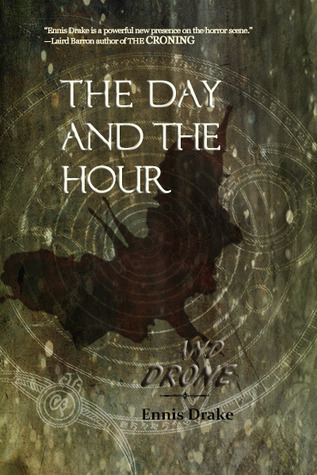
Words In: The Day and the Hour by Ennis Drake

“The Day and the Hour & Drone” is a short book (roughly novella length) containing two stories by Ennis Drake, whose debut novel 28 Teeth of Rage I reviewed previously. As in his debut, Drake’s strength is his artful, powerful prose, as well as the confidence with which he evokes perceptual distortion, hallucination or possibly insanity on the narrator’s part.

drakedayhour

The longer and more ambitious of the two, “The Day and the Hour,” features Jason Grae, a man tormented by his gift of sight and prophecy. Aware in advance of a series of seemingly connected catastrophies, yet unable to stop their cascade, Jason posesses the vision of a divine being along with the seemingly powerlessness of an ordinary man.

“Drone” tells of another tormented soul, in this case the “pilot” or remote operator of a drone aircraft, a fighter in the long-distance conflict modern warfare has become.

Both stories show Drake’s improvement as a writer, and demonstrate ample proof of the confident, poetic style with which he’s capable of drawing a narrative. This writing is full of unrestrained feeling, packed with visual detail and psychological resonance. Ennis Drake shows a dexterity of language and command of narrative that indicate he’s on the verge of even greater things. This is a name to watch.

Control Your Jealousy (For Your Own Good)

I’ve seen a few writers link to this article about professional jealousy. It’s just as applicable to aspiring musicians, artists, ballet dancers, astronauts, athletes and actors. Many of them (us) have lots of friends who are also “the competition,” at least from a certain point of view.

Go read the post, then come back… I’ll wait!

http://therumpus.net/2011/03/dear-sugar-the-rumpus-advice-column-69-we-are-all-savages-inside/

Reflexive envy or jealousy occurs commonly when someone we know, chasing similar goals, finds success that at least momentarily exceeds our own. This sense of “Why not me?” is something everyone must feel at some point.

More than a year ago, I decided to try to stop wallowing in feelings of unfairness or futility related to the struggle against rejection. I’d seen many writers suggest something along the lines of “Forget trying to get published — focus on writing better.” This may seem like the sort of platitude to which the writer replies, “Well, yeah, but…” then returns to obsessing over factors outside their control. But it’s important.

Energy and time spent this way are wasted. Not only are energy and time finite resources, they’re the very stuff out of which our work is built.

To overcome this reflex, to defeat the mindset that someone else’s success means you are now less likely to succeed, is a crucial step toward achieving the resolve, perspective and inward-directedness we need in order to improve.

Imagine if all the energy spent worrying about rejections, fellow writers, unpredictable editors, failing markets, or any other factors outside your control, could be freed-up, reallocated toward fixing plots, strengthening characters, improving voice, refining and improving your writing in every aspect. Not only is this possible, it’s what we all must do.

Next, consider accepting the notion that if we write good enough stories, we will no longer need to worry much about finding places that want to publish them.

For my part, I realized that I was not the best judge of my work’s suitability for publication. That’s something editors get to decide. They don’t have to tell me what they’re looking for, how I fell short, or what to do differently next time. But if I write a story that grabs them and won’t let go, that’s enough. That’s all I have to do.

The “Why not me?” attitude shields the writer from facing the need to improve. Tell yourself the deck is stacked, that it’s all cronyism, and you can’t get published because of race or sex or age or whatever. This absolves you of facing the responsibility to WRITE BETTER STORIES.

I finally let all that go, or at least endeavored to do so, sought that clarity of mind as an ideal, and kept reminding myself whenever backsliding occurred. This allowed me to focus on what really mattered. I improved my writing. I’m still trying to make better stories, all the time, even now that I’ve started finding outlets for my fiction. I work to make myself stronger, rather than worrying about “competition.”

Let go of jealousy. Stop focusing on someone else who got something you wanted. Instead, work harder. You’re not good enough yet to give up trying, put your hands on your hips, and whine about “Why not me?” Really, are you good enough? I know I’m not. We all need to write better stories.

That’s hard enough without worrying about things outside our control.