Methods and Tools

In my years of fiction writing I’ve tried many different methods for coming up words and making a record of them, everything from writing in pencil on legal pads, to writing with a fountain pen on plain white paper, to some old Atari ST word processor, to Wordperfect for DOS, to Word for Windows, then Word for Mac, WriteRoom and assorted other minimal text editors, and finally Scrivener.

I’m actually quite happy working in Scrivener, which is an integrated outlining, organizing, composing and editing application for Mac OSX, in case you haven’t heard of it. Find out more here, at the Scrivener page on the Literature and Latte developer page. But even though I feel as comfortable with Scrivener as with anything else I’ve ever used, I’ve been toying with the idea of trying to dictate some first drafts sections as a way of capturing a different sort of voice (in the writing voice sense, not the spoken voice).

This made me think about all the different possibilities for writing methods and tools, and I decided to undertake a sort of game or experiment. I have several short story ideas pending, ready to draft fairly soon, and ordinarily I’d draft a new one approximately every month, which is about the rate I finalize stories and send them out. I decided I’m going to try to draft one new story per week this month, using a different method and different tools for each.

The four plans are:

1. longhand on plain paper, working from a normal (for me) moderately-developed outline and basic character sketches

2. voice dictation only, working from an extra-detailed outline — more of a move-by-move synopsis, halfway to story form really

3. draft in Writeroom, a distraction free text editor, in case you didn’t know — web site here — using a normal outline and character plan

4. create a story using my usual workflow in Scrivener, using corkboard planning layout, outlining, character notes, and drafting each scene in a separate file

Saturday I began round one and started drafting using a regular old pen and clipboard and paper, just like the old times. Everything went very well at first, when I was full of energy and knew exactly where I was going. I wrote about 2500 words in just a few hours, which is pretty good for me.

I encountered a problem when I began to doubt my outline, and wanted to take the story in a slightly different direction. For some reason, faced with nothing but blank pages ahead of me, I had an unusual sense of uncertainty about forging off in a new direction. It was difficult to sort back through the handwritten scribbles on a dozen or so sheets of paper, enough to get a good sense that I was really correct about my intuition. In other words, I began to doubt myself, to freeze up and have a difficult time figuring out which road to take. It’s possible this reflects a weakness in my outline or the story concept, but I don’t think so. I think the truth is that the breezy confidence I usually feel when I’m laying out a first draft depends to a large degree on the markers I’ve layed out for myself, not only showing the way ahead but also letting me figure out, at a quick backward glance where I’ve just come from.

So, I’m about 2/3 of the way through this story after a few hours work on Saturday and another frustrating hour’s stab at it on Sunday and again this morning, and I’ve already decided round one has taught me all I need to know. I typed in my fifteen longhand pages earlier, and as soon as I finish this blog post, I’m going to create a new Scrivener document and finish this story in there.

When that’s through, I’ll continue with rounds two, three and four, but at this point what I’ve learned is that writing longhand makes me feel adrift, and lost without any point of reference. It’s weird, because I’ve written thousands of pages of first draft that way in my twenties, but that’s where I am now. I’ll retreat to Scrivener, break this baby into scene bits and re-assess whether one bit of bad news happens to character A mid-way, or at the very beginning, and that will determine how character A and character B treat each other up to that point.

Fun stuff, actually. I’ll report back later one once I’ve had a chance to try some other tricks.

Q: What do writers like to do more than writing?

Q: What do writers like to do more than write?

A: Talk about writing!

I’ve always been the solitary sort of writer, whether it was my teen writing efforts, or my “serious” (in retrospect, uptight) literary writing in my twenties, or even more recently. I always read other writers talking about how wonderful Clarion was, or how much fun they have at their weekly/monthly writer’s groups.

OK then. I’ve signed up for a writer’s weekend on the Washington coast. Sort of like a French restaurant called “French restaurant” this writer’s weekend workshop is called “Writer’s Weekend.”

http://www.WritersWeekend.com/.

This thing is in late July, in Moclips, Washington (have never been there — all my NW beach visits have always been Oregon beaches, except once I went to Aberdeen or Hoquiam or something for a few hours — not good). It will include a couple of “writer gurus,” local Portland-based sci-fi-and-fantasy-award-winning-fancy-pants, Jay Lake and David Levine.

I’m somewhat familiar with the work of both guys, and I’ll probably read up a bit more so by the time I meet them I can say something better than “Yeah, I read this one story by you six months ago and if I remember correctly, I thought it was really great.” Actually that’s a smart-ass-ish bit of untruth, as I’ve read multiple short stories by each guy (hard to avoid seeing a Jay Lake short story if you’ve ever bought a single SF magazine or anthology, like ever), and I have two of Jay’s books on my “really oughtta read some time soon” pile. Probably I’ll bump those up and get a copy of David’s cool-looking short story collection.

By my count there may yet be one slot available in the 15 person (not counting gurus) workshop, so if you live nearby here and want to give it a go, then give it a go!

I’m sure I’ll have plenty to say about it as it draws nearer, and particularly during and after. If any of you fellow Writer’s Weekend workshoppers have followed the link in my bio and stumbled over here… hello!

Update of no great consequence

I do seem to run hot and cold when it comes to updating this blog. The good news (as far as I’m concerned) is that I’ve been neglecting my writing-blog-writing because I’ve been doing a lot of plain old fiction writing lately.

I’ve also been very busy sending out a ton of story submissions (the flip side to tons of rejections is tons of new opportunities to submit!) and also putting in a ton of effort refining my workflow.

Some writers just sit down and toss the words out onto the page. I plan a great deal, and assemble mountains of notes and try to sort through them and apply them into suitable little piles relating to the same subject or project. I have this fantastic new tool called Evernote, which is a way of sorting all your notes, including even note-like stuff such as PDFs, sound clips, images and so on. You can apply multiple tags to each “note” so you can look through all your notes with any given tag, and a single note may appear every time you look by the appropriate tag. So I might have a photo of a weird looking goth chick with blue hair, and I could tag it as “image” and “character ideas” and “Hum” (after the name of a story I’m working on) and whichever of these tags I choose, I’ll see this picture. Pretty handy, for sorting through things all different ways, especially once you have thousands of notes.

I’m also increasingly using this great online tool called Dropbox, which gives you a folder on all of your computers which is kept synchronized at all times, so anything you drop into the “My Dropbox” folder on your work PC, for example, is automatically updated in the “My Dropbox” folder on you iPad, your laptop, and your MacPro at home. So great! I used to carry around 2 or 3 little USB thumb drives all the time, and now I’m done with those. Everything I may need during the day, no matter where I am — reference documents, web links, my story projects, software installers, everything! Dropbox is great and includes a free option, for up to 2gb of storage, and a paid option for people who want to store a lot more.

I’ll be back soon with subsequent SF Academy entries, and maybe a bit more about what I’ve been writing lately.

Griffin’s Theory on Rejection and Recovery

It’s easy to write stories — just type a bunch of words, and after a while you’ve got a story. What’s tougher is to show the stories to other people, tougher still to send them to editors whose professional mandate is to reject very nearly 100% of everything sent to them. That’s the deal you sign up for, though, if your goal is not only to write words but to form them into stories, and then to see the work published. You have to send the work out.

You have to detach a bit, remind yourself how long the odds are, especially for a new writer. Not only must the story be top-notch, it also needs to be the right fit at the right time. Even after moderating expectations, even if you’re the thickest-skinned, most confident individual, when a story comes back with a rejection form there’s still at least a twinge of disappointment.

Writers have to be self-assured, and full of the buzz of their own competence, in order to produce good work. The narrator needs to be able to proceed with that affirmative “Yes!” attitude underlying the putting of new words to the page. How best to reconcile these two things, then: the diminishment of self-esteem that occurs each time a submission comes back, and the upkeep of one’s own confidence in the face of repeated, frequent rejections?

My theory is that each rejection unavoidably represents a small chipping-away of the foundation of self-assurance. If the writer wants to keep going, to avoid ending up reduced to a self-loathing drunk who no longer writes a word – or worse, one of those writers who keeps writing but stops sending things out — the task is to reduce the damage. I try to help myself on two fronts.

First, I keep disappointment in perspective when a rejection comes back. I remind myself of all the usual stuff: It’s not personal. Plenty of great stories are rejected many times before finding a home or even winning awards. All my favorite writers accumulated many more rejections than I’ve yet seen. And so on.

Aside from trying to reduce the “damage” from each rejection by rationalization, though, I also spend time on the opposite effort. That is, rather than minimizing damage from the outside, I try to shore up confidence from the inside. Make goals, and keep track of progress toward them. This reminds me I’m doing all I can toward creating good work, and getting it out there. I also revisit earlier works I consider most successful periodically, to remind myself I know how to form a great story and write compelling words when I work a story through all the many drafts and revisions.

Every writer unavoidably faces knock-downs or disappointments. I try to keep my foundation strong by working hard, keeping track of forward progress, and occasionally pulling out one of my better final drafts and studying it. It can help to read interviews by writers who have made it, to take heart in their stories of struggle, of wallpapering their offices with rejection slips before finally breaking through. In many of life’s endeavors it’s enough just to work hard, but in some things such as the art of writing fiction, you have to not only work hard, but persist. That means making effort along the way to keep one’s morale propped up and avoid discouragement taking hold.

Now Working, March 2010

I often mention my own writing in general terms here, but I’d like to start talking about more specifics. Not so much because I think a lot of people out there (or ANY people out there) are following my work at this point, but because I believe spelling out goals and processes helps clarify them for myself.

Also once I’m an established bestseller, it’ll be a fun larf for people to scroll back to these earliest blog posts and think, “Gee whiz, remember how it was then?”

OK, this is really more about that first reason than that second reason. Quick breakdown, then, of what I’m working on lately. I just finished a short story (when I say “finished” I mean revisions totally complete, not “I wrote a first draft”) about a murderer imprisoned in a strange penal colony, which happens to be on the moon. Plagued by nightmares, he volunteers for a strange experiment related to dreams, which he hopes will cure his nightmares, though that’s not the experiment’s aim.

I’ve spent most of my time this week brainstorming an idea for a novel, not that I intend to actually write the novel any time soon. I’ll keep focusing on short stories the next six months at least. But enough rough ideas for this novel had accumulated that I wanted to coalesce them into a short synopsis, set of outlines/plans, and character lists. It’s set in a near-future Seattle, drastically changed not only from today’s Seattle, but the rest of the world too. It delves into body modification, experimental biotech, brain implants, pleasure games, various forms of addiction, AI tools for trading financial instruments, and more. I’ll probably work on this here and there through the summer, try to hammer out a clear synopsis of 20-30 pages, make sure the interlocking relationships are worked out, then set it aside to gel.

I’m in middle revision stages of the most “space opera” thing I’ve written. It takes place in a transit station at the outer edge of the solar system, where humanity is trying to extend outward by building a series of jumping-off points. It involves a nifty transportation technology I can’t wait to explore further (in other related stories), as well as other cool, strange details I had fun inventing but don’t want to give away here. This was was a lot of fun, with a sort of retro science fiction feel. It’s also the longest short story I’ve written, about 10k words, and I’m trying to decide whether to just go with it, or lose a lot of great stuff by paring it down to under 7500 or so. This one’s fun, sexy, strange, full of wonder, adventure and even a little action. Hell, it’s got ray guns and spaceships! I’d love to write more like this in the future, get away from the too-internalized, slower-paced, “literary” trap I often get stuck in.

I’m also doing final revisions on a long-ish story set 50 or so years in the future, following an apparently wealthy guy from resort to resort around the world, starting in fun, still flashy, future Las Vegas. But this fella’s not an ordinary rich guy, seems to find an unusual amount of trouble, and worries a lot about people following him. I tried to create an enjoyable ride, watching him bounce around while learning who he really is and why he lives like this. I hope to have this one finished and sent out by the end of April.

I have four stories in circulation at various magazines, including the first one I mentioned. My goal is to finish at least one new story per month, and start enough new ones to keep the assembly line fed with raw material. I tend to do many revisions, somewhere between ten and twenty drafts, so in the past that’s meant keeping at least eight or ten stories working at any given time, in different stages. Right now I’m trying to make each revision go a little deeper in to the story, and do fewer “rounds” of revision. In other words I’d rather do seven really intensive revisions than twenty that are mostly surface-level.

Currently I have a list of about thirty “seeds” for stories — brief ideas, partial outlines, or full synopses — and I seem to add to this list of rough stuff faster than I withdraw from it. Often, though, I’ll end up combining two or even three separate ideas into one more complex idea: “Hey, maybe the ‘mind-controlled babysitter on a laser-rifle killing-spree’ story can be combined with the ‘silicon-based aliens from Mercury attack Earth’ story?!” Listen, man, don’t steal that idea!

Recently I set aside all my pre-SF stories, of which six had been completed, and decided not to spread my attention too thin by trying to find markets for those, at least for now. To keep things clearer for myself, I’m working on SF only at this point, setting aside all other work whether finished, in progress, or just planned.

So, quick recap: I’m trying to finish roughly one new story per month, start approximately that many new ones, keep adding raw idea stuff to the list of upcoming story plans, and spending a little time on the side planning the Seattle novel. I have four short stories finished and circulating among short fiction markets. That’s where things stand, and I’ll try to post updates whenever anything changes in an interesting way, like if I get published, switch to writing porn, or whatever.

Internet, enemy of creative focus

Television was originally seen as this great technology to allow people all over to keep informed of world events, and to find all kinds of free entertainment in the home, only to turn into the world’s great motivation-sucking-time-waster. Something similar, and more modern has evolved, a sort of interactive television. I’m talking about the internet.

TV set

On one hand, the internet is an incredibly powerful tool. The advent of near-ubiquitous internet connectivity has allowed all kinds of great efficiencies like paying bills or doing research or communicating with friends online. On the other hand, though, it’s a potentially detrimental distraction or time sink. It can be so much fun, you almost don’t realize, or maybe don’t care, how much time you’ve wasted.

I don’t care about the loss in business productivity from all the people browsing fantasy football leagues on espn.com, or gossip on thesuperficial.com about Paris Hilton’s latest pix, or any of the many blogs, forums, facebook profiles, youtubes, tumblrs or tweets. I mean, business owners should care (and any corporate IT manager can tell you most people’s work computers are used a lot more for screwing around than for work), but that’s not what interests me here.

Paris Hilton making an adjustment

I’m talking about people like myself sitting down to the computer for my own reasons, to work on a project that’s important to me. Let’s say I’m trying to work on some music or graphic design for my record label, Hypnos Recordings, or in my downstairs office trying to get some writing or editing done. Often I’ll think “I’ll just do this little bit of research about which street the UN building is on,” or maybe, “It’ll take two seconds to find out how many moons Neptune has,” or perhaps, “I think I’ll check out that little Russian record label and listen to some of their mp3 sample clips.”

The next thing I know ninety minutes have passed and I’m somewhere deep in web-land, nowhere near where I started out.

The internet has really made a million things easier, sometimes to benefit the user, and more often to benefit a business providing web content, deriving profit from the continued attention of your eyeballs. In other words, the web started out as a way of getting interesting information in front of people who wanted it, but it has evolved into mostly just a way of getting you to look at stuff with advertisements embedded in it. Some web sites, such as Amazon.com or Netflix.com or Youtube.com have spent a lot of time and money developing tools that let them say “We see you are interested in this thing you came here for… perhaps you may also be interested in these many other similar things you didn’t know about?”

How many times have you gone to Youtube to look at a clever video link someone sent you, only to end up watching a half-dozen or more other videos you arrived with no intention of watching? There you are an hour later, watching that dumb kid ride his BMX bike into a brick wall, or an old lady smash a folding chair and fall on her ass, or this.

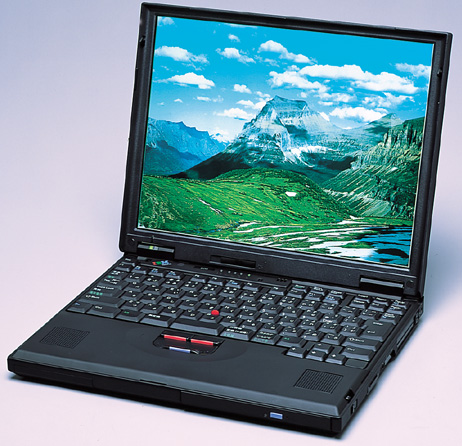
Something I’ve tried recently is using an old laptop as my writing computer, an old IBM ThinkPad. I don’t particularly like the keyboard, and I hate the lower-resolution screen which makes it hard to fit a whole page on the screen at once. But this machine has no wireless, and it’s nowhere near an ethernet plug, so it’s effectively just a word processor. I’d rather write on a newer computer with a nicer monitor and a keyboard with better touch, and yet I get a lot more accomplished on this IBM because I have no distractions. I just sit down with this thing on my lap and I listen to the music playing from the other side of the room, and I write just like I used to write in the years before the internet came along.

The IBM ThinkPad -- it sucks so much, it's wonderful!

At first I hated this old machine, but then I remembered its very limitations are why I chose it. I’m getting a lot more done, this past few months since I started using it. I’ve often thought of getting an old OS7-era Mac laptop for this purpose, but what I have is working well enough for my needs. I wouldn’t want this to be my only computer, or even my main computer, but again, in this case the limitations constitute the whole point.

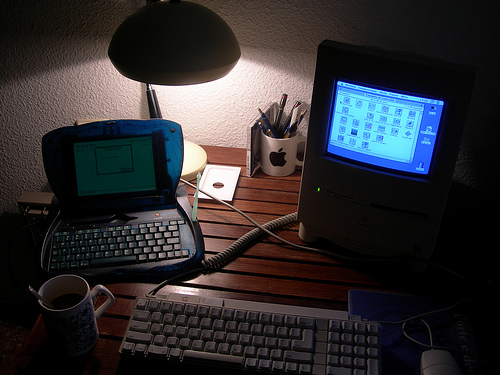
Today I stumbled upon a blog entry by someone using an old Mac in a similar way.

Mac Color Classic setup (see SystemFolder blog link below)

Visit Vintage Writing Corner on systemfolder.wordpress.com

My first response upon reading this blog entry, unavoidably despite my own success using an old, “crippled” machine, was to focus on all the things the machine couldn’t do. Gahhh, what about USB?! Again, that’s the point, taking away options and especially removing the temptation of the internet, in the name of a more direct approach to creativity.

I wouldn’t go so far as an old typewriter, as the word processor’s ability to save and edit without having to re-type revised drafts in their entirety is something I really couldn’t do without. I’m a fast typist but who wants to waste that much time?

Another option I stumbled upon, via the same fantastic tumblr/blog incidentally, Minimal Mac, is this simple application that allows a user to voluntarily lock themselves out of any internet connection for a pre-determined period of time.

To me, this seems like it could allow the best of all worlds. I could use my preferred machine, with the best possible monitor and keyboard, and whatever software I choose, without any temptation (during a set writing period or other creative “window”) to screw around online. I wonder if others have had the same amount of frustration at their own time-wasting, or if most people just don’t mind hours spent on wikipedia or amazon. Maybe everyone has a lot more discipline and self-control than I do, but having looked over a few shoulders in my day, I’d say not.

Words Out: A New Hope

Most of these blog entries have been about books I’ve read recently, or crazy authors I’ve enjoyed, but my earlier-this-week blog entry “Words in, words out” said a bit about my own writing, at least the earlier stage of that.

So when we left off, I had left off my own fiction writing between the time I was almost thirty, and more recently (I’m forty-three now) when I’d decided I was interested in picking it back up.

I didn’t just grab a pen and paper, or computer word process, and get started spewing words. I spent quite a bit of time daydreaming and planning, re-reading some of my earlier work, and thinking about what kind of work I felt motivated to create. Those early stories (and novels and poems) were mostly straight “literary” fiction, that is, stories about people being serious, joking around, relating to each other, and… feeling ways about stuff. Some of them, the ones that remained interesting to me, were more experimental, or looked at reality through a different lens.

pen-paper

I thought about the books and stories I’d most enjoyed reading, simply as a reader, not as a writer comparing himself or looking for inspiration. Then I considered, aside from what I most enjoyed as a spectator of good writing, what sort of stories would it excite me to create?

I realized I wanted to create new worlds, different worlds from this real one, not only different in the sense of having imagined people in them, walking around and worrying about concerns exactly like the concerns of the people in this real world. I mean entirely different worlds, different concerns, different rules. I want to imagine wider possibilities. It excites me to imagine a future in which our world is different, things have changed in ways that are sometimes shocking, at least interesting.

In the end I decided I can write whatever I want but I also need to consider what kind of “markets” (a really seedy and overly commercial-sounding word, to most people, but one writers throw about and mean nothing worse by it than “places I might send my stories) to consider. That means slotting the work a genre and I guess I’d say we’re talking about Science Fiction here.

Dune

Now, the irritating ass-hole voice in the back of my mind complained a little bit. I mean the arrogant jerk who majored in Literature (big “L”) in college, and who, despite really loving Harlan Ellison and Frank Herbert and assorted others, still kinda felt like Science Fiction was a sort of less-serious, less-literary genre. This discussion has come up a few times before, on the Hypnos Forum (a discussion board related to my record label, Hypnos Recordings) where there are many sci-fi fans including one who’s an editor at Asimov’s. This came up before I was writing, and I was acknowledging that voice in the back of my own mind when it came to the regard of science fiction from a reader’s point of view, not as a writer. But I can’t help think back to it, and halfway try to talk myself out of getting involved in it, knowing that the little condescending, snobby voice is there in the back of my head.

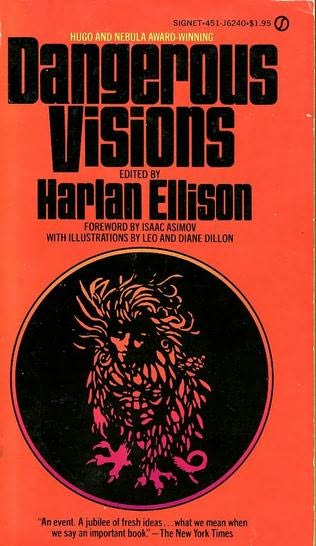
Dangerous Visions

In the end, I decided the little voice can just get over itself, and I will follow what my gut tells me is right. The truth is, I get as excited about a good new science fiction movie as about any other kind of movie. Most of my favorite TV shows (Battlestar Galactica, Firefly, Star Trek, etc.) are science fiction. More and more, when I think about reading a book for pure enjoyment, I think of something like Greg Bear or Gregory Benford, or more recently Robert J. Sawyer or Stephen Baxter or especially Robert Charles Wilson. I’ve recently become infatuated with Greg Egan, only to find that at times his books are infuriatingly, willfully unfriendly to the reader… but I’m as excited to explore the rest of his work as I am about any other writer I can think of.

Spin

Undoubtedly I’ll write some things that sci-fi purists may look at and say “Hmm, not enough spaceships,” and I’ll have to figure out what to do with some of my stories. But when the first subjects I want to write about include artificial intelligence and robotics and life extension and simulated reality, and the environments I want to explore include the future Earth, outer space, and other planets, I become increasingly comfortable just settling into that genre and starting to explore.

I’ve written about fifteen stories in a very short time, some just a first draft, and a couple of them nearly finished. I’ve plotted out a connected story cycle, begun to lay-out one novel, and made notes toward a few other novel ideas. I’m writing better, more quickly, and with greater pleasure than at any time before, and I feel I’ve just started again. The things I’m writing now are more considered, more mature, and certainly more geared toward a readership outside of my own brain, than what I did when I was younger. I like the idea of having stories published at some point, but I’m also enjoying the process of getting the words out and then carefully re-working and polishing them, so I won’t hurry the whole “publication chase” aspect. It seems to me that if the writing is good, then the possibility of getting things into magazines will follow. I think it is a real flaw of many writers, certainly was a flaw of mine when I was younger, to push the whole “must get published, must get published!” overdrive with much greater energy and priority than what SHOULD be one’s primary motive, “must get better, must do the best work possible.”

Before too long I’ll start to be more specific about some of the things I’m working on and planning, and may even post a little word-blurb excerpt of actual written fiction, at some point. But the above gets us up to date, as far as the whole “Words Out” side of things.

Words in, words out

When I started this blog it was not only to talk about things I’m reading, but also my own writing… but that’s an aspect I haven’t written about at all, yet, in this space.

So, a quick recap for those of you who don’t know who I am, or only know me through the electronic music “M. Griffin,” or know me personally but didn’t know I was into writing fiction.

I was a Lit major in college, at University of Oregon in the 80s. During that time, when I wasn’t worshipping at the Ernest Hemingway altar in my off-campus apartment, or hanging around with my Zelda Fitzgerald-like girlfriend of that year, I was experimenting with words, writing weird poetry, even weirder one-act surrealist plays, and gradually a bit of short fiction. My last year, I set myself the goal of writing a novel before I graduated. I did complete an angst-ridden, rather immature novel called Bright Fever, but it was more of an exercise than a serious attempt to write something that might be published, and I never even seriously considered sending it out.

After college I became more serious about short stories and wrote a couple dozen terse, minimalistic stories that I sent out to magazines without much luck (only one short fragment published in Missisippi Review), and took a couple of slightly more ambitious attempts at the novel.

Some time in my late twenties, while living in Seattle, I wrote another angst-ridden and rather immature novel called Hum. This one was a lot more interesting, getting into territory that might be called metaphysical or surrealist, having to do with a protagonist who learns how to “shift” reality slightly so that he’s able to exit out of the world inhabited by other people, and move about in a differently-shaded version of the Seattle he knows, but with virtually all the people gone.

Hum never went anywhere (again, didn’t send it out to any publishers or agents or really anybody outside my household), but it remains a concept I’d like to revisit and possibly incorporate into a more broad and complex idea I’ve had. So there may be more discussion of that title here in the future.

Not long after that, I moved back to Portland and entered a 3-day Novel contest, and one Memorial Day weekend sat down with two cases of Coca Cola and wrote, from two pages of notes, a short novel called House of Longest Days. I had originally planned a story by that title about people who inhabit a house that allows them to live in a young, carefree and surrounded-by-friends state forever, but this concept was somewhat more normal than original plan. It ended up being a story about a handful of former college friends retreating to the large home of one wealthy friend (does it sound like The Big Chill yet?) and sort of catching up on each other, realizing how different they’ve all become, and airing all their unresolved bullshit. It’s actually much less like The Big Chill than my synopsis makes it sound, and much stranger… the basement of the house has a number of secret or semi-secret “theme” rooms into which people disappear for little adventures (the room of fire, the room of color, the pillow room, etc.) This one was, finally, sent off to be read by people unrelated to me. My third novel did not win the contest, but I didn’t expect it would.

Big Chill

I continued with the short stories for a while, and became a bit more ambitious, and a bit less terse and minimal (communing just as often with the spirit of Fitzgerald as Hemingway), though I had also discovered Raymond Carver by that time and become obsessed by him, so who knows.

Then I was about to turn thirty, and went through a really awful breakup after which I took a break from writing. I figured I would pick up again (and I even have some notes and outlines I put on paper during the “not writing for a while” stage) but I became involved in ambient music, started recording my own material, started my record label and became too busy with that to work on any of the other creative activities I’d previously enjoyed.

Somehow I always knew that I would find my way back to writing fiction, and I hoped that my new “life experience” and maturity would allow me to be more brutally honest and self-critical when I resumed writing again.

Fast forward, now, twelve years or so.

I was married a couple of years ago to a fantastic woman named Lena who is very supportive and encouraging of all my creative urges and endeavors. At some point she gave voice to an idea that I’d heard in my head a few times, which was that despite all the time I spend on electronic music, and various other art forms, what I’m really “meant” to do is write. So I chewed on this for a while, and last year I had a feeling that it was time to go through some of my earlier writing and think about it.

I came away from that rearward glimpse both encouraged and discouraged. On one hand, some of the writing I had revisited was very good, by some measures. A lot of the language, the scenery and descriptive stuff, and the dialogue in particular, had some very fine moments. On the other hand, most of the stories were more vignettes than actual stories. Those that had at least some hint of plot, didn’t have much development. In the end my assessment was that this young writer had some skill and some promise but he needed to grow the hell up, and start thinking less about his own poetic convolutions, and give more consideration to the experience of the reader.

I will save for another post (soon, probably) the story of how I actually began writing again, how it went, how it’s going, and what I hope may become of it.