Words In: Chick Bassist by Ross Lockhart

Chick Bassist is Ross Lockhart’s debut as a writer of fiction, after establishing himself as a fantasy and horror editor best known for two successful Lovecraftian “Book of Cthulhu” anthologies. Despite Lockhart’s genre editing background, the only fantasy in Chick Bassist is of the rock-and-roll variety.

Chick Bassist

This book is crazy fun, often funny, but it also has a serious feel, as troubling and difficult as real life. It tracks the passions and conflicts of an enjoyably grungy cast of dysfunctional characters, every one of them f**ked up in a charmingly rock-and-roll sort of way. Lockhart realistically captures the fun and filth of the garage music scene, the transitory existences of bands, the passionate creativity and train-wreck lifestyles. The characters and their scene are clearly personally known to the author, and will seem familiar to anyone who has played in bands or at least been part of that milieu.

Told from multiple viewpoints, the story not only switching character perspectives, but also juggling first, second and third person points of view. The title refers to Erin Locke, “the Queen of Rock,” who leads the band Heroes for Goats until things implode, and she takes off to play bass for a more successful band. Other points of view follow Robbie Snow, the bassist kicked out of Heroes for Goats for acting all mental after Erin had sex with him, and Christian, who ends up getting a severe beating by Robbie after Erin makes Christian kick him out of the band.

At its best, rock and roll is about ambition and failure, about lessons learned too late, about love, and also death. Chick Bassist is crammed full of these things. If you think you might enjoy a punk/grunge flavored book about underground bands and musicians, you’ll love this Chick Bassist. I browsed the first pages of this book when I was already in the middle of reading something else, and this one immediately sucked me in.

As for the “Would you read a sequel?” test, Chick Bassist easily passes. I’d gladly read the further adventures of Lockhart’s rock and roll characters. Bring it on!

The Lure of Devouring Light Endorsed Again

Another nice review of my story “The Lure of Devouring Light,” which appeared in the latest April 2013 issue of Apex Magazine.

Last week, a Locus reviewed that issue of Apex, and singled out my story for the “RECOMMENDED” stamp of approval. That recommendation is hard to come by.

More recently, an English reviews site called SF Crows Nest did a similar review of that issue of Apex, and came to a similar conclusion.

Very encouraging!

Lovecraft eZine Issue #23

The Kindle edition of Lovecraft eZine, issue #23, is now available!

lovecraftezine23

This includes my story “Nectar of Strange Lips,” as well as stories by Joe Pulver and Edward Morris, Samantha Henderson and Andrew Nicolle, Douglas Wynne, Wendy Wagner, Cora Pop, and non-fiction by Robert M. Price.

Kindle version – Lovecraft eZine Issue #23

You can also follow this link to obtain a FREE (at least for now) download of the audio/podcast version of this issue.

Three-Pronged Writing Update

Several things happening on the fiction writing front.

My story “The Lure of Devouring Light” in the latest Apex Magazine received a very favorable review in Locus Magazine (the SF/Fantasy trade journal) this week.


http://www.locusmag.com/Reviews/#apex201304

If you haven’t read “Lure of Devouring Light” yet, and are intrigued enough by the mini-review to give it a look, it’s available to read for free online. Again, I’d like to thank everyone at Apex for making this happen!

http://www.apex-magazine.com/the-lure-of-devouring-light/

Some other things coming soon…

The next issue of Black Static magazine (#34, May 2013) will contain my story “Arches and Pillars.” I’ll have more information about this as May approaches.

The next issue of Lovecraft eZine (#23, April 2013) will include my story “Nectar of Strange Lips.” The issue is not yet available to read, but you can purchase the podcast/audio version now, for just 99 cents!

http://lovecraftzine.com/2013/03/03/11884/

That’s not 99 cents for just my story, but 99 cents for the entire issue, all the stories and Robert Price’s new nonfiction feature… almost 3 1/2 hours of great stuff!

Words In: Fungi, ed. Orrin Gray & Silvia Garcia-Moreno

Fungi, edited by Orrin Gray and Silvia Garcia-Moreno, collects about two dozen weird and fantastic stories focused on the theme of fungus, including mushrooms, molds and a whole related class of bizarre life forms.

I expected mostly dark tales of decay and derangement, but many of the tales here turn out to be lighthearted, whimsical, even silly. Whatever one’s preference in terms of tone, Fungi undeniably contains a healthy measure of strong genre fiction. Whether due to my own predisposition toward more serious horror and dark fantasy, or because the more playful efforts are not as strong, I consider the most successful stories here to be those darkest or most surreal in tone. The work of John Langan, Laird Barron, and E. Catherine Tobler stood apart in my estimation.

Image

Langan’s lead-off “Hyphae” is a concentrated dose of nastiness. I dare anyone to read this without at least once letting out a disgusted, shuddering moan. I haven’t seen Langan write something so viscerally gruesome until this. So awful, yet wonderful. I loved it.

Laird Barron never disappoints, and his “Gamma,” a cynical yet emotionally powerful survey of childhood, adulthood, entropy and decay, balances a boy’s recollection of his father killing a lame horse named Gamma against a present-day, adult contemplation of his wife leaving him for another man. The story looks outward to embrace death and human existence more generally, and finally broadens to face horror on a truly cosmic scale.

It’s worth noting that E. Catherine Tobler’s “New Feet Within My Garden Go,” which may well be my favorite piece in the book, is a bonus story present in the hardcover but not the paperback version of Fungi. It’s a shame many readers will miss Tobler’s tale, which is complex, detail-rich, and overflowing with delicious, poetic weirdness. Beautifully and artfully told.

Another handful of stories deserve mention. Nick Mamatas describes in “The Shaft Through the Middle of It All” an apartment building where fungus growing in a ventilation shaft can bring harm to residents, though another use of fungus brings a kind of retributive power. J.T. Glover’s “The Flaming Exodus of the Greifswald Grimoire” tells of two brother sorcerers, adventuring grimoire hunters who find trouble when they try to snatch a tempting tome in a house they assume is empty. Paul Tremblay’s “Our Stories Will Live Forever” has the feel of straight realism, until a character dealing with terror of flying undergoes a transformation. Lastly, “The Pilgrims of Parthen,” by a writer new to me, Kristopher Reisz, suggests a society taken over by the visionary trips brought on by newly discovered mushrooms, which seem to transport the user into a distinct and transcendent separate reality.

Several more, despite falling short of total success in my judgement, possess strengths of expression or concept sufficient to at least partly recommend them. These include works by W.H. Pugmire, Ian Rogers, Daniel Mills, Jeff VanderMeer and A.C. Wise. Also, one humorous story in Fungi that I think works (by virtue of going way over the top) is Molly Tanzer and Jesse Bullington’s “Tubby McMungus, Fat From Fungus,” which describes a showdown between rival merkin-makers for fashion-conscious society felines.

Where other stories fell short, lapsing into slightness or forgettability, was often in making a story’s entire point nothing more than someone being consumed by mold, or surprised by the druggy effects of mushrooms. Of course, some that miss the mark for one reader may please others looking for different approaches to the subject. Whatever tone the reader prefers, Fungi contains a more than sufficient number of challenging and artful takes on the theme. Readers receptive to the fungal theme, and familiar with at least some of the authors contained here, should find in Fungi a successful weird fiction anthology and an overall satisfying read.

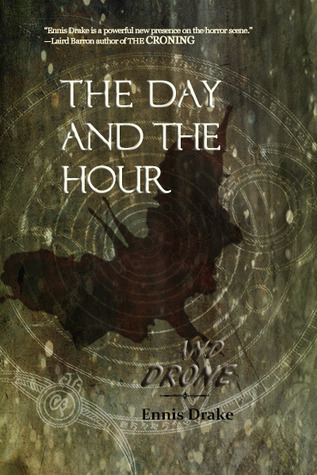
Words In: The Day and the Hour by Ennis Drake

“The Day and the Hour & Drone” is a short book (roughly novella length) containing two stories by Ennis Drake, whose debut novel 28 Teeth of Rage I reviewed previously. As in his debut, Drake’s strength is his artful, powerful prose, as well as the confidence with which he evokes perceptual distortion, hallucination or possibly insanity on the narrator’s part.

drakedayhour

The longer and more ambitious of the two, “The Day and the Hour,” features Jason Grae, a man tormented by his gift of sight and prophecy. Aware in advance of a series of seemingly connected catastrophies, yet unable to stop their cascade, Jason posesses the vision of a divine being along with the seemingly powerlessness of an ordinary man.

“Drone” tells of another tormented soul, in this case the “pilot” or remote operator of a drone aircraft, a fighter in the long-distance conflict modern warfare has become.

Both stories show Drake’s improvement as a writer, and demonstrate ample proof of the confident, poetic style with which he’s capable of drawing a narrative. This writing is full of unrestrained feeling, packed with visual detail and psychological resonance. Ennis Drake shows a dexterity of language and command of narrative that indicate he’s on the verge of even greater things. This is a name to watch.

Control Your Jealousy (For Your Own Good)

I’ve seen a few writers link to this article about professional jealousy. It’s just as applicable to aspiring musicians, artists, ballet dancers, astronauts, athletes and actors. Many of them (us) have lots of friends who are also “the competition,” at least from a certain point of view.

Go read the post, then come back… I’ll wait!

http://therumpus.net/2011/03/dear-sugar-the-rumpus-advice-column-69-we-are-all-savages-inside/

Reflexive envy or jealousy occurs commonly when someone we know, chasing similar goals, finds success that at least momentarily exceeds our own. This sense of “Why not me?” is something everyone must feel at some point.

More than a year ago, I decided to try to stop wallowing in feelings of unfairness or futility related to the struggle against rejection. I’d seen many writers suggest something along the lines of “Forget trying to get published — focus on writing better.” This may seem like the sort of platitude to which the writer replies, “Well, yeah, but…” then returns to obsessing over factors outside their control. But it’s important.

Energy and time spent this way are wasted. Not only are energy and time finite resources, they’re the very stuff out of which our work is built.

To overcome this reflex, to defeat the mindset that someone else’s success means you are now less likely to succeed, is a crucial step toward achieving the resolve, perspective and inward-directedness we need in order to improve.

Imagine if all the energy spent worrying about rejections, fellow writers, unpredictable editors, failing markets, or any other factors outside your control, could be freed-up, reallocated toward fixing plots, strengthening characters, improving voice, refining and improving your writing in every aspect. Not only is this possible, it’s what we all must do.

Next, consider accepting the notion that if we write good enough stories, we will no longer need to worry much about finding places that want to publish them.

For my part, I realized that I was not the best judge of my work’s suitability for publication. That’s something editors get to decide. They don’t have to tell me what they’re looking for, how I fell short, or what to do differently next time. But if I write a story that grabs them and won’t let go, that’s enough. That’s all I have to do.

The “Why not me?” attitude shields the writer from facing the need to improve. Tell yourself the deck is stacked, that it’s all cronyism, and you can’t get published because of race or sex or age or whatever. This absolves you of facing the responsibility to WRITE BETTER STORIES.

I finally let all that go, or at least endeavored to do so, sought that clarity of mind as an ideal, and kept reminding myself whenever backsliding occurred. This allowed me to focus on what really mattered. I improved my writing. I’m still trying to make better stories, all the time, even now that I’ve started finding outlets for my fiction. I work to make myself stronger, rather than worrying about “competition.”

Let go of jealousy. Stop focusing on someone else who got something you wanted. Instead, work harder. You’re not good enough yet to give up trying, put your hands on your hips, and whine about “Why not me?” Really, are you good enough? I know I’m not. We all need to write better stories.

That’s hard enough without worrying about things outside our control.

Weekend Update: Check Out “The Lure of Devouring Light”

Last Tuesday, the new April issue of Apex Magazine appeared, featuring my story “The Lure of Devouring Light.” I’ve already received some nice feedback, from friends, family, fellow writers, and even a NY literary agent. In case you missed my previous post about this, here’s a reminder, and a link to read the story for free, or purchase a PDF or a (Kindle) MOBI or (iPad/Nook) EPUB file of the entire issue for $2.99.

http://www.apex-magazine.com/the-lure-of-devouring-light/

Thanks again to the great and talented people at Apex.

My Story “The Lure of Devouring Light” in Apex Mag

My story “The Lure of Devouring Light” is now available in the April 2013 issue of Apex Magazine. I’m very proud and excited to have a story of mine appearing in such an excellent and prominent periodical.

I’ll have more to say about this magazine and this story, but for now, here’s a link. It’s available to read for free, and you can also purchase a PDF or a (Kindle) MOBI or (iPad/Nook) EPUB file.

http://www.apex-magazine.com/the-lure-of-devouring-light/

http://www.apex-magazine.com/the-lure-of-devouring-light/

My thanks to Editor Lynne Thomas and Publisher Jason Sizemore for featuring my work!