Dancer In the Dark

Last night I was awakened from a deep sleep by the overlapping sounds of a car alarm and extremely loud dance/techno music outside. The family across the street includes a high school boy, and sometimes when his friends drop him off they briefly raise hell in various harmless ways out front. The clock said 1:35 and I thought that was a little late for this kid to get home on a weeknight during school so I got up and peeked through the blinds.

A silver car had pulled up in front of the neighbor kid’s little red Toyota, and the visiting car had all the doors open and the music blasting. Outside the car was a teenage girl in her underwear dancing like a lunatic to the music. The car alarm was going off because the girl was beating on the hood of the kid’s Toyota as part of her meth-fueled Flashdance re-enactment. One or two other kids stayed in the silver car while she continued dancing. At first I thought this was a dare of some kind — “hey, we’ll drive up to Joey’s house and you have to get out of the car in your underwear and dance” — but this went on for several minutes.

I’m not sure what this means, but I decided I’d rather sleep than watch an underwear-clad high school girl dance in her underwear in the street outside my house. I climbed back in bed before the dancing and the music finished.

Value of Workshopping

Many writers swear by the value of workshopping. Some enjoy the social aspect, some need others to help them assess their own stories, and some find that casting an editorial eye upon the works of others helps them understand flaws of style or narrative, and spot them.

Others say writing is a solitary pursuit and that if you can’t figure out what’s wrong with your own work, nobody else is going to fix it for you. They point out you could run a re-named Hemingway story through most workshops and get all manner of fatuous complaints and suggestions about what the story clearly lacked.

I see something in both sides of the argument. Generally I’ve worked alone, and asked only my wife’s opinion between my stories’ many revisions. At times, though, I’ve sought the opinions of others. I attended a Writers Weekend up in Moclips, Washington last summer. In February I took part in an online “intensive workshop” through The Cult forums (offshoot of Chuck Palahniuk’s web site), and since the end of that intensive I’ve posted a few stories on the Cult forum member area for online critique, and critiqued many stories by other writers.

Maybe the biggest benefit has come from reading the works of others and helping to pinpoint flaws. I feel this has really sharpened my editorial eye, which helps me better assess my own work. If I read a story with a clear-cut need for better-defined motivation for the protagonist and express this to the writer, I find that afterward I’m better able to spot similar flaws in my own stories.

The most useful thing, though, is using other writers as a barometer to judge my own writing. It’s pretty hard to gauge one’s own progress by a string of form rejections. The rejections of a clueless unskilled beginning look much the same as the rejections of someone who’s almost there, just one lucky “right place, right time” submission away from getting into print.

The encouragement and validation of my fellow writers, particularly those whose work I respect, has been a big boost to my confidence. I suppose once I’m past the publication barrier, this aspect will be less valuable. I’ll have the ultimate validation of editors, in that they’ve selected my story to publish. For now, though, this is the aspect of workshopping I’ve found most useful.

The Good and Bad Sides of Improvement

In the past six months, and especially in the past two or three, my writing has jumped ahead several notches. I think this is less a matter of becoming better or more fluent at putting words on the page, and more a matter of improving my critical eye’s ability to perceive my own work. That is, I’m able to see more clearly what’s working and what’s not, and what needs to be changed in order to execute on the page the idea that exists in my head.

This is a good thing in most ways. The new stories I begin are much better than what I’ve written before, and I’ve been able to make significant changes and improvements to “stuck” stories that I’ve had in progress for a while.

If there’s a downside, it’s that every time I take another look at an earlier story I’d considered “finished,” I find so many things I want to change that I’m afraid to reopen old stories for fear of never getting anything done on new ones.

I do realize this is a good problem to have. I’m getting better. I’m sharpening the skills that will make more stories more effective and help get them out into the world. But I’m really not sure what to do about this. Do I pull all my earlier stories out of circulation and trunk them until I have time to go over them again? Do I keep sending them out, even knowing that I could probably improve them now, and certainly could do a better job writing the story from scratch if I just started over?

I’ve probably (OK, definitely) already wasted too much time in the past six months re-working old, flawed stories. The effort hasn’t been entirely wasted, because I’ve learned a lot about the mechanics of a broken story. I’m better at spotting a story with a protagonist who coasts through without risk or real motivation, or a front-loaded plot that just trails off. Part of this recently learning experience is because of all that “wasted” time. Sometimes I think, though, that once I’ve diagnosed the problem, I might be better off just starting a new story than trying to figure out a way to retrofit the current set of characters, settings and actions into something more suitable.

One thing that really does bother me is that I’ve been very good about immediately re-submitting rejected stories without second-guessing them, delaying, or looking for reasons not to send them out again. I think that’s a good trait to have, and I kind of wish I could shut off this sense I have that it might be better to reel these ten or so finished pieces back in and rework all of them.

Not exactly looking for answers here, just venting a little.

Books Lately

Just some very brief notes on books I’m reading or recently finished.

As I’ve mentioned here before, I often read several short story collections or anthologies at once. I take one or two stories from each and move on. I’m currently working through “Fugue State” by Brian Evenson, “Compositions For the Young and Old” by Paul Tremblay, “Blood Will Have Its Season” by Joseph S. Pulver Jr.. Also I’m near the end of two collections I’ve been savoring slowly for months, “Saffron and Brimstone” by Elizabeth Hand, and “The Imago Sequence” by Laird Barron, in fact I’ve finished other books by both writers since I began these.

Every one of the above books is absolutely top-notch and I feel like I’ve discovered more wonderful writers in the last year than in the previous decade.

I’m reading a biography of Donald Barthelme, a writer I haven’t read much since the 90s but who used to be one of my favorites. It’s called “Hidden Man” and it’s actually quite engaging and interesting as biographies go (I often find them hit and miss).

The biggest reading event of this year for me has been the “Border Trilogy” of Cormac McCarthy, which is comprised by his novels “All the Pretty Horses,” “The Crossing” and “Cities of the Plain.” I think I had put off approaching this trilogy for two reasons. First, the film adaptation starring Matt Damon and Penelope Cruz gave me the impression the whole thing would be lighthearted and romantic, and second, the structure of the trilogy (which is to say only a disjointed connection between the three books, with no characters in common between the first and second, and only one character from each of the two books appearing in the third) put me off a little. These books are nowhere near as mushy and feminine as the previews for the “Pretty Horses” movie made it seem, in fact the movie itself is nowhere near that romantic. Female characters don’t

The significant connection between the three novels is that despite the variation in character and the time gaps between books, all occur in the border area between the USA and Mexico, and all three involve crossings between the two lands as significant plot elements. The books are as stark and as harsh as the rest of McCarthy’s work, and a recurring theme is the attempt of a character to rescue a doomed or wounded friend, woman, child or animal. The landscape and the horses are as significant as any of the characters or plot events, and the narrative style varies from simple prose to poetry, from straightforward linear clarity to an almost ranting, biblical convolution.

There is never a question with McCarthy that he is writing about things that matter deeply to him, and that conviction and passion come through on the page. I consider him the most powerful and significant living writer, at least in the English language. If anybody out there hasn’t yet been convinced to read him by the various awards, the worshipful reviews, or even Oprah or the several film versions of his books, consider this yet another voice telling you, “If you read anything at all, you must read Cormac McCarthy.”

200 Proof Storytelling, Weeks 3-4

I’m always busy and over-scheduled, so time always flies by, but since the beginning of February I’ve been extra busy due to the online writing workshop I mentioned in my last post here. I won’t recap what it was all about, so just read the prior post if you don’t know what I’m talking about.

High Desert, Starless Sky

In weeks 1-2 I derived quite a bit from the lectures and used the assignments to write the first two scenes of a quiet but horrific post-apocalypze story which I’m just now finishing up. The first two scenes were the first half of the story, roughly, and I received some good feedback and felt very motivated to work on finishing the story even while I was busy with the next two weeks of lessons, assignments and critiques.

Invisible Mystic and the Alien-in-a-Jar

Speaking of those, for week 3 I started an entirely new story. Due to the nature of the assignment it didn’t seem like a great “fit” for writing the next part of the earlier story, so I started a new story about a traveling freakshow that is unusual even by the standards of traveling freakshows. Again I received very nice feedback and I’m using that momentum to finish up that story this week.

Devotion

The week 4 assignment involved revising, and while most of the other participants in the workshop just revised what they had written earlier in the workshop, I went back to the last story I’d drafted just prior to the workshop. This piece involved a strange religious community and the feedback I received, including that from workshop leader Craig Clevenger, was extremely positive and encouraging. I’ve since polished the story to completion (not too hard since it’s only 1,300 words) and started submitting it to magazines.

By the end of the workshop I could see some other participants were discouraged and ready to give up. Four of the sixteen participants never submitted their fourth assignment, and many of us who did submit didn’t receive critiques from all members of our groups. I actually felt more motivated and energized by the process, despite the fatigue and hard work. Writing is usually such solitary work. It can be easy to find yourself in an endless, lonely feedback loop of “write story, submit story, get story repeatedly rejected.” This was a nice change and a boost to my confidence and skill level. I enjoyed both the challenges that took me out of my comfort zone (and I believe that’s the only way one can grow), and also the positive feedback about my writing.

200 Proof Storytelling, Weeks 1-2

I recently mentioned that I’d signed up for an online writing workshop led by Craig Clevenger, author of Dermaphoria and The Contortionist’s Handbook, and run through Chuck Palahniuk’s web forum, The Cult. It’s a 4-week intensive, and the info page is here, though it’s obviously too late to sign up.

I was a bit worried about this demanding too much of my time and attention, not because I’m not willing to work hard, but because I already have so many demands on my time and I was worried I might not be able to displace enough of those other things to make room for this workshop. As things turned out, I needn’t have worried. I’ve been able to keep up easily, have met all the deadlines, and I’ve put plenty of time into all the critiques I’ve written.

The way it works, in case anybody reading this might be interested in doing one of these in the future, is fairly straightforward. Each week Craig posts a “lesson” or lecture on a part of the Cult forums visible only to participants. In that lesson he talks at length, and with plenty of examples from outside text, about whatever concept is the focus of each week. In week one, the lesson used a bunch of dialog from the film Sexy Beast to make a point, and I found it instructive to watch the DVD as a supplement to the lesson. Craig answers any questions people may have about the lesson, then the next day he posts a writing assignment having to do with the subject of that week’s lesson. Participants have until the end of the week to finish the assignment and post it, and they can ask more questions along the way if they like. In addition to the lessons and assignments Craig gives the participants, and the questions we feed back to him, there’s also a fair bit of discussion and chit-chat among the students which is kind of fun. As I said, by the end of the week we post our assignments (in both cases it’s been about 1,500 words of fiction, a scene or a story fragment or whatever, utilizing the technique or approach from that week’s lesson.

We’re divided into four peer groups of four individuals each, and we have to read and critique the work of other members of our peer group. We’re also welcome to read and critique work outside our peer group, but most people seem to have kept within their group. In addition to these peer groups, for each assignment Craig chooses a selection (it appears to be two of the four peer groups, or half the participants, chosen at random) for inclusion in the “Hot Seat” where he critiques those assignments for everyone to see.

As with my last workshop experience, I’ve found at least as much value in critiquing the work of others as in receiving their suggestions. I can really see how reading slush would teach a writer to catch mistakes or shortcomings in written fiction, and it makes a lot of sense to me why fiction writers offer to read slush for various periodicals, often without compensation.

I won’t give any more “behind the curtain” details because obviously there is a charge for the workshop and it wouldn’t be fair to give away any of the content. I will say that so far I’ve received some real value from the critiques, learned a lot more from the critiques I’ve given, and above all have gained a lot of value from Craig’s suggestions just in the first two lessons. I’ll report more later, probably after the end, but so far I’d consider this to be very worthwhile. My first two assignments ended up being scene 1 and scene 2 of the same story, so if nothing else I’ve got the bulk of a story that I feel has some real strengths. As well, I’ve made some good new contacts, all kinds of people from beginners to more experienced, publication-worthy writers.

Coming Up: 200 Proof Storytelling

Writing-wise, I’ve been churning along lately. Keeping busy, starting some new stories and revisiting some old ones. Trying to take a slightly different approach to voice and POV. Lena, my wife, has been a big help as a first reader. She’s helped me figure out where I’m accomplishing what I intended, and where I’m not. Fiction writing is always a pretty solitary pursuit and I don’t mind that, but I’ve been giving some thought to trying to engage some kind of outside connection. Maybe join an online critique group, or some kind of local workshop. As I was mulling this over, I saw an announcement for this online “intensive” workshop through Chuck Palahniuk’s web site. They’ve had a series of these 4-week or 6-week intensives, and this one is led by Craig Clevenger, author of Dermaphoria and The Contortionist’s Handbook. Craig’s wikipedia page is here for more info.

Announcement for 200 Proof Storytelling Feb 2011.

We’ll see how this goes. I’m looking forward to a bit of challenge, as I seem to do my best work under deadline, or for a contest, or within imposed restrictions. I’ll post about it here, at least a little bit, as time allows.

So many books, part 1

I’ve bought so many books in the past few months, going back to a Thanksgiving trip to Lincoln City, I couldn’t begin to list them all. So much great stuff, though. Even more than usual, my reading has been fragmented. A bit of this, a bit of that. Two or three novels at a time, maybe a non-fiction book on the iPad, and multiple short story collections going all at once. Plus, I usually listen to an audiobook during my commute, generally something “light” or pop-fiction-ish, because it’s too hard to listen to complex, literary or multi-threaded stuff while driving. Some current and recent items of note include:

Generation Loss by Elizabeth Hand
This is my “main read” at the moment, a fascinating and strange novel, but not strange in the usual Elizabeth Hand way. This feels creepy, disjointed and somewhat horror-like, despite the apparent absence of any supernatural or “speculative” element. It’s basically the story of a very troubled woman who used to be a photographer, but whose life has degenerated in various ways to a point where she not only can’t practice her art any more, but can’t relate to or interact with people in any kind of functional way any more. She gets an offer to go interview one of her heroes, a reclusive and strange, and also somewhat broken and unproductive, photographic artist on an island in Maine. As I said, though this is published by Small Beer Press (Kelly Link’s own imprint) there seems to be nothing fantastic, unreal or supernatural going on. Just a lot of weird, troubled people in interesting circumstances. I’m enjoying this as much as any novel I’ve read in the last few years.

Forever War by Joe Haldeman
Another “top recent novel” experience for me, this one I stretched out over a long period of time, though it’s not long. I’ve read some other things, such as John Scalzi’s novel Old Man’s War, which obviously derive from this, and yet Forever War was so well-done, strongly characterized and confidently executed, it felt completely fresh to me. So often as I go back through classics of science fiction and fantasy, I find the quality of the writing to be very poor. It’s wonderful to find someone writing clear, expressive prose. When I read Joe Haldeman, I never find myself second-guessing the way he does things. He’s a writer I’ll definitely continue to explore in the future.

The Autopsy and Other Stories by Michael Shea
I saw Michael Shea read at the HP Lovecraft festival, and in fact my first exposure to his work was in Ellen Datlow’s Lovecraft Unbound anthology, not long before the festival. I think I heard about this particular book, the beautiful Centipede Press collection, on Laird Barron’s blog, when he mentioned writing the foreword for this edition. When one of my own favorite new writers calls out one of his own influences and favorites, it grabs my attention. I almost didn’t go for this book because it’s very expensive, but I had some Amazon.com gift cards from Christmas and they were offering the book cheaper. I normally try to buy direct and support smaller presses, but nobody gave me a $125 gift certificate to Centipede Press. This is a beautiful book, so much that I’ll definitely give consideration to Centipede editions in the future. Well-bound, beautiful paper, very nice illustrations, enough that I really feel the book is worth the high price. What I’ve read so far leads me to believe I’ll really enjoy the rest of it. Shea writes with a strong, poetic voice, and the stories display a wild, energetic inventiveness. I’m holding off on reading the title story, for now. I’ve heard so many good things about it, and I want to save it.

There are many more (even just counting the highlights) so I’ll post this now, and do another installment or two soon.

R.I.P. Mick Karn

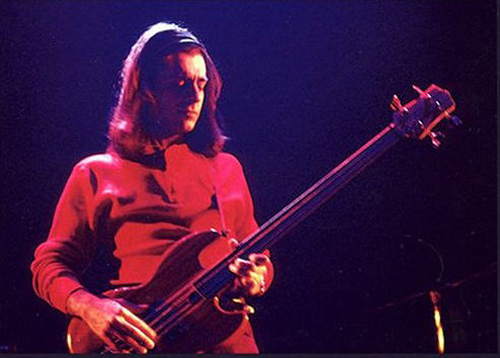
One of my favorite instrumentalists, starting in the 80s (original bassist of Japan) and onward until the present, has passed away. Though Karn was best known for his work with Japan, he collaborated with many other artists such as Peter Murphy (post-Bauhaus duo Dali’s Car, which released only one album), Gary Numan (bass on the Dance album), Terry Bozzio (member of Zappa’s band and founder of Missing Persons), and David Torn. Karn was a self-taught master of bass guitar, and did as much to popularize the a fluid style of play on a fretless electric bass as anyone short of Jaco Pastorius.

Not a major name, unknown to most, but this is a very great loss. Mick Karn will be missed by many.

Mick’s alien stage, strongly influenced by Bowie here.

Here he is in the red suit. This is the Oil On Canvas lineup of Japan. Guitarist Rob Dean had been sacked, and Masami Tsuchiya (of Ippu Do, and later contributor to Arcadia’s So Red the Rose) played Dean’s parts.

Here he is with Angie Bowie… not sure why, or what the connection is, other than “I so love your ex-husband’s makeup!”

Later Karn, eyebrows grown back, hair grown long. I think this is somewhere in the later 80s, after Dali’s Car and Dreams of Reason Produce Monsters.

More discussion here on the Hypnos Forum.

The Future is Here!

The Future is Here!

I’ve just subscribed to the electronic version of a magazine, in this case Locus.

Too bad I can’t magically transform the enormous stacks of various paper magazines all over my house into epub or pdf versions — or better yet, super-magically get access to epub of pdf versions of long-last magazines from my past. I’d really enjoy reading old copies of Questar and Mondo 2000 and Twilight Zone, and even Wired and Interview before they both turned silly.