The Complete Des Lewis Real-Time Review

Des Lewis has completed his real-time review of The Lure of Devouring Light. You can read all the installments HERE. Scroll down to the comments to see his coverage of each individual story.

On Facebook, he also described the book as “near-perfect,” which is pretty great.

Thank you, Des, for all the time and effort you put into this! It’s my great pleasure to have my own real-time review, after enjoying many of your previous efforts.

Words In: At Fear’s Altar by Richard Gavin

I kept reflecting, as I read Richard Gavin’s fourth collection At Fear’s Altar, about what horror fiction ought to be. Horror stories should be dark, disquieting. Too often what passes for “horror” is mundane or predictable. Whereas familiarity can be a virtue in some genres, where readers seek the recurring comfort of touchstones, horror by its very nature should unsettle.

Richard Gavin’s work stands out as chillingly dark, wickedly strange and otherworldly. These stories have the heart-pounding feel of nightmare, and carry a strong suggestion of the numinous. Where other writers offer familiar monsters in comfortable territory, always stopping short of threatening the reader, Gavin explores the weird and surreal just as much as the horrific. His strength is conveying an otherness, something looming out there, threatening. There’s a commonality with the cosmic horror of Lovecraft, but I find a greater kinship to the spooky occultism of Machen and Blackwood, whose best stories have at their heart a sense of something unknowable happening just out of view, completely out of proportion with human experience, and vibrating on an entirely different wavelength.

atfearsaltar

Highlights include “Chapel in the Reeds,” in which an elderly man moves back home with his daughter, who doesn’t want him there. The man wanders the countryside, seeming to shift into different realms, seeking a strange, mystic chapel, and speaking with his late wife. His young granddaughters are frightened when they witness his strange behavior, standing in the middle of a field, talking to no one. His daughter thinks he’s disintegrating, while he remains focused on finding the chapel again. Whether his reality or his daughter’s is most true, either possibility is disturbing.

In “The Abject,” Petra watches an eclipse, along with her husband tad and two male friends. Out across the water is a jagged island know as The Abject, about which Petra’s friend recounts a legend. Petra has a vision of proto-humans on the spire, and feels dangerously drawn to go there herself.

The main character in “A Pallid Devil, Bearing Cypress” walks the streets among falling bombs in a time of war in Europe. He’s trying to see the devil, feeling sensitively attuned to the city’s shadow side, and thinks he sees something. He finds a broken Cypress flower, red and star shaped, the spots a devilish, horned creature. Excited and inspired, thinking he’s found the devil he seeks, he then hears the cries of a girl trapped under rubble, and leaves her, trying to chase the devil. After he loses track, he to Helma and helps her out from under the rock. They connect, end up marrying, though not too happily. He’s still preoccupied with seeking darkness. They move out to the country, and nights he roams near their new house, looking for the devil’s traces. At times he finds these scattered Cypress flowers, but never quite what he seeks. Finally he learns Helma too is seeking something.

“King Him” is a shocking story of domestic unease, an adult brother and sister living together. She thinks he’s the crazy one, insisting on talking about an entity called “King Him.” Maybe he’s insane, maybe they both are, or maybe King Him is the real cause of the dysfunction creeping into their relationship.

“Only Enuma Elish” is a good example of Gavin’s treatment of characters with supernatural or occult beliefs. This story’s narrator meets an older woman across the street, and she introduces him to the book “Enuma Elish,” a tale of the universe’s creation, from ancient Babylon.

In “Darksome Leaves,” an isolated, socially awkward man becomes attracted to a young woman in his apartment building. His hopes of getting closer to her shift when they discover an ominous mask.

By far the book’s longest and most ambitious story, “The Eldritch Faith,” is both philosophical and metaphysical in its focus. It follows a boy who grows up seeking to understand reality’s true nature, to find a way out of the depressingly mundane ordinary existence. He comes up with a game called Curtains which he believes allows a ghost or spirit to communicate with him, and possibly enter our world. This exploration unfolds gradually, and feels chillingly real. His interactions with the entity he comes to know as Capricorn are among the more creepy and unnerving things I’ve ever read. “The Eldritch Faith,” which concludes the collection, exemplifies what Gavin is capable of.

At Fear’s Altar achieves heights — or perhaps depths — of darkness and disquiet almost unrivaled in recent horror fiction. It’s among the few most notable and impressive story collections I’ve read in the past five years. With this book, Gavin rises in my estimation to rank among the strongest practitioners of horror and weird fiction currently active. At Fear’s Altar is my first exposure to Gavin’s fiction, but now I gladly anticipate the pleasure of going back to investigate Charnel Wine (2004), Omens (2007), and The Darkly Splendid Realm (2009).Even more, I eagerly anticipate Gavin’s future works.

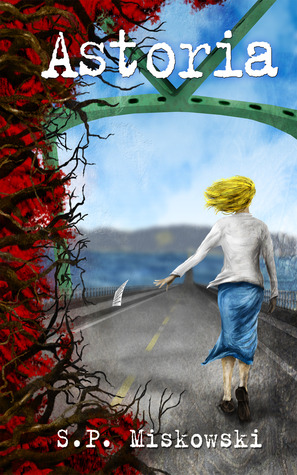
Word In: Astoria by S.P. Miskowski

Astoria is the second in a series of novellas linked to S.P. Miskowski’s Shirley Jackson Award nominated debut, Knock Knock. Each of the linked works follows a different spoke outward from the hub of Knock Knock’s primary characters, a trio of young girls and their immediate families.

One of these is Ethel Sanders, stuck in a life she finds unbearable. She reacts to sudden tragedy by abruptly fleeing Skillute, Washington, the small town she’s lived in all her life. Ethel not only leaves home, but steps out of her whole identity like shed skin. She travels down the Columbia river, which divides Oregon and Washington, toward the small coastal town of Astoria, on the Oregon side. There she tries on aspects of a new life, picking up elements one at a time, fantasizing that all of it’s real. Ethel clings to belief in the possibility of an unhappy middle-aged woman simply leaving behind the mundane existence that caused her dissatisfaction, to truly start over. For a while, it seems she’s reinvented herself, truly run away from the elements in her life that troubled her. But has something come along for the ride? Her escape may not be what it seems.

Astoria Cover

At times, Miskowski’s approach reminds me of Stephen King’s. Many attribute King’s lasting popularity to the horrific story elements, but I’ve always believed what he does best is tell the story from a place so intimately wound up in a character’s perspective that the reader feels as if they’re living someone else’s experience. Miskowski too writes in a style straightforward and transparent, yet vivid and always engaging. A deceptively simple narrative surface hides churning layers of confusion, pain and psychological turmoil.

Just as in Knock Knock Miskowski leads the reader to identify with the primary characters, in Astoria’s we share Ethel’s turmoil, her desperate grasping at a possible alternate future life. Every time she seems to have taken a step closer to this goal of reinvention, she seems to slip deeper into a state of delusion or self-deception. By the end, Ethel’s situation seems at once more settled, almost domestic, and also nightmarish. Astoria is the most accomplished work of fiction yet from S.P. Miskowski, an author still improving, achieving stronger effects. It’s a work of confidence, of engrossing atmosphere and real narrative control, strongly recommended.

Catching Up With Incoming Words

No, I have not written three entire book reviews in under 24 hours.

I’ve been way behind on posting reviews of some of the books I’ve read, including some I finished reading months ago. This backlog was stressing me out! Some of the reviews were mostly written and just needed to be assembled. In other cases, handwritten notes just needed to be typed up.

It feels good to clear the decks a bit.

I will probably cut down on the number of reviews I’ll write for a while… after I get through a few things like At Fear’s Altar and Jagannath and Staring Into the Abyss and Hair Side, Flesh Side.

I do love to talk about books and writers, and possibly help in some small way to boost those that deserve it. I also think it’s helpful, in a selfish way, for writers to think carefully and critically about other people’s writing. What works, what doesn’t, and why. It’s always seemed to me that writers derive more benefit from giving critiques than receiving them.

Despite my enjoyment of this book review thang, I need to scale back, at least for a while, the self-imposed sense of obligation. I’ll still talk about the books I’ve read, probably more briefly and off-the-cuff.

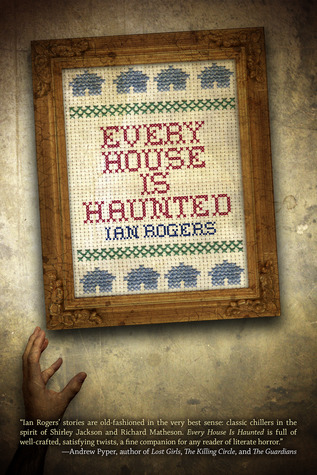
Words In: Every House is Haunted by Ian Rogers

Many of the 22 short stories in Every House is Haunted, the debut collection by Ian Rogers, feel connected. As the title suggests, this is a book about hauntings, though the stories Rogers tells venture beyond the well-worn template of the haunted house tale. On top of this unifying theme, several stories also feature paranormal investigators, something like agents Mulder and Scully of the X-Files, or hint at a shadowy group overseeing such intrusions. Rogers seeks to establish a common world in which paranormal events and entities are controlled, studied and policed by a broad and shadowy organization devoted to these functions.

Every House is Haunted

Rogers starts off strong with “Aces,” on its surface a routine family drama in which Toby’s sister has trouble in school and exhibits weird behavior, like many adolescents. This seeming normalcy masks the extreme strangeness of what’s really going on with the sister, who is obsessed with finding “aces,” playing cards which she discovers in strange places, such has hovering in mid-air. Toby only comes to understand his sister’s unusual nature when paranormal investigators arrive and explain.

Another strange and surreal piece early in the book, “A Night at the Library With the Gods” again displays Rogers’ skill for creating a familiar, mostly normal world, then gradually increasing the strangeness until the reader recognizes they’re in something more akin to nightmare. In “The Dark and the Young,” linguist Wendy takes a mysterious job, translating an occult “black book.” Some of the rituals described in this bizarre text make Wendy and some of her coworkers hesitant to participate.

A few less mature stories are sprinkled throughout, and in my opinion Rogers could have made a stronger debut impression by omitting these. I understand the desire to include early work, and indeed this flaw is so common in first collections I’m hesitant to mention it. At any rate, the few less-compelling pieces are more than offset by a high overall quality. The more recent stories seem generally darker, more macabre or surreal.Rogers closes the collection with a powerful series of tales, deftly and confidently told.

In “The Inheritor,” Daniel Ramis unexpectedly inherits a house from his father, with whom he had a terrible relationship. He visits the childhood home, a place evoking the terrible memory of his sister’s early death. Daniel always thought his father had sold the house when he moved, and can’t understand why he’d held onto it. Along with the house, Daniel is also left contents of safe deposit box: a gun, and a note from his father hinting at explanation. All that remains is for Daniel to discover what responsibility comprises the most horrible aspect of his father’s legacy.

A husband in “The Candle” gives his wife a guilt trip about possibly forgetting to blow out a candle before coming to bed. Time passes, and feeling guilty, he goes downstairs and finds something weird and disquieting in the dark. Here’s another story that starts off realistic, then takes a weird disconnect, making a subtle and eerie observation of the ways we open gaps in relationships through small acts of selfishness or distrust.

The last tale, “The Secret Door” makes a powerful ending to the book. Sarah and husband move into an old country house, and find a secret door bricked up on back side. She sleeps, and wakes again to find her husband’s not there. Other details, such as the bed and their car, inexplicably have changed. The story veers more deeply into surrealism. Sarah envisions a boy yelling from the bottom of a well, telling her she’s the one who put him there, hinting at connection to her earlier decision never to have kids. Her experience swerves between alternating realities, now alone and sick, then with her husband telling her she’s not well. It depicts increasing detachment from reality, a creepy back-and-forth between the real and the surreal.

Every House is Haunted is an above-average short fiction collection, especially noteworthy as a debut. The writing is both transparent enough for mainstream readers, and artful enough for those who like their prose with an edge. At his best, Rogers is very compelling, and the growth demonstrated within these pages suggest he’s one to watch.

Words In: Die, You Donut Bastards by Cameron Pierce

Die, You Donut Bastards is the latest collection of short fiction and prose poetry by Cameron Pierce. The whimsical title and cover art may suggest a mostly humorous approach to Bizarro, a genre which can range from arty surrealism to shock-focused extremity, and also at times encompassing more conventional storytelling with a subtler twinge of the surreal. While many authors focus on a single approach, Pierce here shows himself capable of covering all the bases.

Die You Doughnut Bastards

Most of the pieces are just a page or two, and focus on wild invention and playful absurdity. I detect in these shorter works the influence of Russell Edson, the master of surrealist prose poetry, though Pierce is less oblique, less blatantly symbolic, and more confrontational. Readers approaching this book from outside the Bizarro realm can expect a lot of zany humor and intentional absurdity, but will also discover a great degree of subtlety and sensitivity. In fact, those seeking a full-on Bizarro blast may be surprised by the restraint and emotional honesty present in the longer stories.

The lengthiest of these, “Lantern Jaws,” is a lovely tale of wonder and emotion, both subtle and graceful, reminiscent of something Kelly Link might create. In it, a teenage boy falls in love with a girl schoolmate who carries a vaguely Lovecraftian doom or curse. It’s a gentle, touching story, characteristics which may seem at odds with some of the extremes on display elsewhere in the book, yet it’s also quite dreamlike and surreal.

Another longer story, “Death Card” shows a couple, Tristan and Emily, shifting from youthful, carefree obsessions, such as Tristan’s comics and his collection of vinyl figures, to more adult concerns now that Emily is pregnant. Tristan goes along, half-reluctantly boxing up his collection to make a room for the baby. The story focuses the feelings of impending loss and disconnection from self, arising from Tristan’s recognition that life’s simple freedoms and youthful pleasures are soon to change.

In “Pablo Riviera, Depressed, Overweight, Age 31, Goes to the Mall,” an odd outsider catalogs an endless stream of pleasures, mostly fast food, during a trip to a shopping mall. This litany of cheeseburgers, taco corn dogs, and other excessive treats could be seen as Pablo’s attempt to numb the pain of his solitude and isolation, or perhaps simply exhibits the weirdly alienating effect of our obsession on grotesque, commercialized pleasures.

“Disappear” is the weird story of a pregnant woman’s baby disappearing right out of her belly. It turns out the fetus was stolen by horror author Stephen King, who apparently steals unborn babies and installs them into his typewriter as fuel or grist for new stories.

In “Mitchell Farnsworth,” one of the more transgressive pieces, Katie recollects once having sex with her boyfriend, the Mitchell Farnsworth of the title, while watching the movie Alien. After Mitchell moves on, the story recounts Katie’s long string of boyfriends, forming a detailed catalog of explicit sex acts, foods and drinks consumed, and the movies she watched with each — often Alien, sometimes The Exorcist or other horror films. Katie is increasingly stuck, unable to stop and reflect on this pattern, until she hears news about Mitchell Farnsworth.

In Die, You Donut Bastards, the shorter, weirder stories are greatest in number, and seem more geared toward a Bizarro audience. The longer stories, comprising about half the collection’s page count, exhibit greater emotional realism and even a bit more seriousness mixed in with the strange pop surrealism. I enjoyed the provocative range of styles, moods and approaches on display in Die, You Donut Bastards. It makes me eager to check out more Pierce’s work.

Words In: Chick Bassist by Ross Lockhart

Chick Bassist is Ross Lockhart’s debut as a writer of fiction, after establishing himself as a fantasy and horror editor best known for two successful Lovecraftian “Book of Cthulhu” anthologies. Despite Lockhart’s genre editing background, the only fantasy in Chick Bassist is of the rock-and-roll variety.

Chick Bassist

This book is crazy fun, often funny, but it also has a serious feel, as troubling and difficult as real life. It tracks the passions and conflicts of an enjoyably grungy cast of dysfunctional characters, every one of them f**ked up in a charmingly rock-and-roll sort of way. Lockhart realistically captures the fun and filth of the garage music scene, the transitory existences of bands, the passionate creativity and train-wreck lifestyles. The characters and their scene are clearly personally known to the author, and will seem familiar to anyone who has played in bands or at least been part of that milieu.

Told from multiple viewpoints, the story not only switching character perspectives, but also juggling first, second and third person points of view. The title refers to Erin Locke, “the Queen of Rock,” who leads the band Heroes for Goats until things implode, and she takes off to play bass for a more successful band. Other points of view follow Robbie Snow, the bassist kicked out of Heroes for Goats for acting all mental after Erin had sex with him, and Christian, who ends up getting a severe beating by Robbie after Erin makes Christian kick him out of the band.

At its best, rock and roll is about ambition and failure, about lessons learned too late, about love, and also death. Chick Bassist is crammed full of these things. If you think you might enjoy a punk/grunge flavored book about underground bands and musicians, you’ll love this Chick Bassist. I browsed the first pages of this book when I was already in the middle of reading something else, and this one immediately sucked me in.

As for the “Would you read a sequel?” test, Chick Bassist easily passes. I’d gladly read the further adventures of Lockhart’s rock and roll characters. Bring it on!

The Lure of Devouring Light Endorsed Again

Another nice review of my story “The Lure of Devouring Light,” which appeared in the latest April 2013 issue of Apex Magazine.

Last week, a Locus reviewed that issue of Apex, and singled out my story for the “RECOMMENDED” stamp of approval. That recommendation is hard to come by.

More recently, an English reviews site called SF Crows Nest did a similar review of that issue of Apex, and came to a similar conclusion.

Very encouraging!

Words In: Fungi, ed. Orrin Gray & Silvia Garcia-Moreno

Fungi, edited by Orrin Gray and Silvia Garcia-Moreno, collects about two dozen weird and fantastic stories focused on the theme of fungus, including mushrooms, molds and a whole related class of bizarre life forms.

I expected mostly dark tales of decay and derangement, but many of the tales here turn out to be lighthearted, whimsical, even silly. Whatever one’s preference in terms of tone, Fungi undeniably contains a healthy measure of strong genre fiction. Whether due to my own predisposition toward more serious horror and dark fantasy, or because the more playful efforts are not as strong, I consider the most successful stories here to be those darkest or most surreal in tone. The work of John Langan, Laird Barron, and E. Catherine Tobler stood apart in my estimation.

Image

Langan’s lead-off “Hyphae” is a concentrated dose of nastiness. I dare anyone to read this without at least once letting out a disgusted, shuddering moan. I haven’t seen Langan write something so viscerally gruesome until this. So awful, yet wonderful. I loved it.

Laird Barron never disappoints, and his “Gamma,” a cynical yet emotionally powerful survey of childhood, adulthood, entropy and decay, balances a boy’s recollection of his father killing a lame horse named Gamma against a present-day, adult contemplation of his wife leaving him for another man. The story looks outward to embrace death and human existence more generally, and finally broadens to face horror on a truly cosmic scale.

It’s worth noting that E. Catherine Tobler’s “New Feet Within My Garden Go,” which may well be my favorite piece in the book, is a bonus story present in the hardcover but not the paperback version of Fungi. It’s a shame many readers will miss Tobler’s tale, which is complex, detail-rich, and overflowing with delicious, poetic weirdness. Beautifully and artfully told.

Another handful of stories deserve mention. Nick Mamatas describes in “The Shaft Through the Middle of It All” an apartment building where fungus growing in a ventilation shaft can bring harm to residents, though another use of fungus brings a kind of retributive power. J.T. Glover’s “The Flaming Exodus of the Greifswald Grimoire” tells of two brother sorcerers, adventuring grimoire hunters who find trouble when they try to snatch a tempting tome in a house they assume is empty. Paul Tremblay’s “Our Stories Will Live Forever” has the feel of straight realism, until a character dealing with terror of flying undergoes a transformation. Lastly, “The Pilgrims of Parthen,” by a writer new to me, Kristopher Reisz, suggests a society taken over by the visionary trips brought on by newly discovered mushrooms, which seem to transport the user into a distinct and transcendent separate reality.

Several more, despite falling short of total success in my judgement, possess strengths of expression or concept sufficient to at least partly recommend them. These include works by W.H. Pugmire, Ian Rogers, Daniel Mills, Jeff VanderMeer and A.C. Wise. Also, one humorous story in Fungi that I think works (by virtue of going way over the top) is Molly Tanzer and Jesse Bullington’s “Tubby McMungus, Fat From Fungus,” which describes a showdown between rival merkin-makers for fashion-conscious society felines.

Where other stories fell short, lapsing into slightness or forgettability, was often in making a story’s entire point nothing more than someone being consumed by mold, or surprised by the druggy effects of mushrooms. Of course, some that miss the mark for one reader may please others looking for different approaches to the subject. Whatever tone the reader prefers, Fungi contains a more than sufficient number of challenging and artful takes on the theme. Readers receptive to the fungal theme, and familiar with at least some of the authors contained here, should find in Fungi a successful weird fiction anthology and an overall satisfying read.

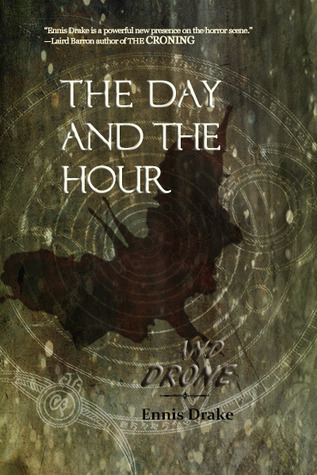
Words In: The Day and the Hour by Ennis Drake

“The Day and the Hour & Drone” is a short book (roughly novella length) containing two stories by Ennis Drake, whose debut novel 28 Teeth of Rage I reviewed previously. As in his debut, Drake’s strength is his artful, powerful prose, as well as the confidence with which he evokes perceptual distortion, hallucination or possibly insanity on the narrator’s part.

drakedayhour

The longer and more ambitious of the two, “The Day and the Hour,” features Jason Grae, a man tormented by his gift of sight and prophecy. Aware in advance of a series of seemingly connected catastrophies, yet unable to stop their cascade, Jason posesses the vision of a divine being along with the seemingly powerlessness of an ordinary man.

“Drone” tells of another tormented soul, in this case the “pilot” or remote operator of a drone aircraft, a fighter in the long-distance conflict modern warfare has become.

Both stories show Drake’s improvement as a writer, and demonstrate ample proof of the confident, poetic style with which he’s capable of drawing a narrative. This writing is full of unrestrained feeling, packed with visual detail and psychological resonance. Ennis Drake shows a dexterity of language and command of narrative that indicate he’s on the verge of even greater things. This is a name to watch.